
Freeze dried fruit powder clumping causes are rarely limited to one bad seal. Fruit powders contain sugars and organic acids, often have high exposed surface area, and may exist in an amorphous state that becomes sticky as water and temperature increase molecular mobility. Packaging is critical, but the investigation should also examine formulation, drying end point, milling, particle distribution, cooling, compression, and the way the powder is used.
A useful diagnosis begins by describing the clump. Is it a soft lump that breaks under light pressure, a hard cake attached to the liner, a sticky mass near the seal, or a gradual loss of flow through the feeder? The location, timing, and strength of the clump help separate humidity exposure from thermal, mechanical, and formulation effects.
Moisture Pickup Lowers Powder Stability
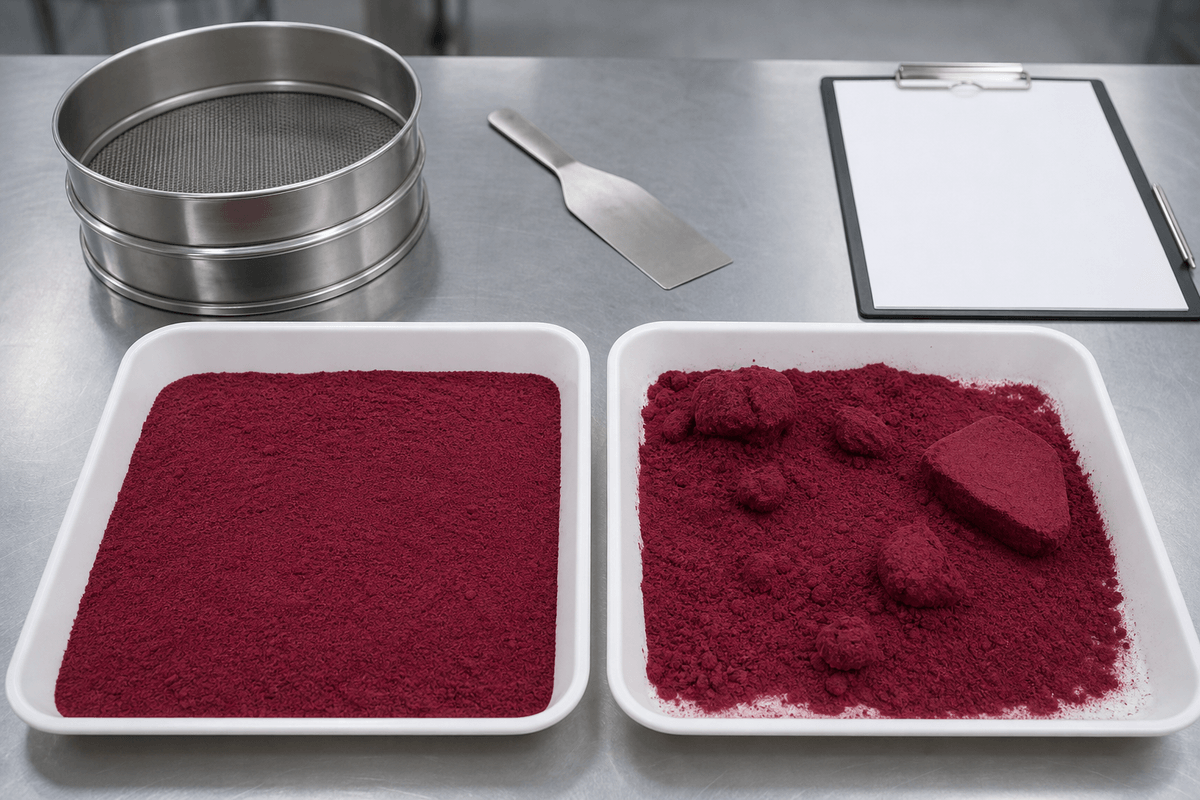
Research on amorphous carbohydrate powders shows that water sorption can lower glass transition temperature through plasticization. When storage temperature is high relative to the powder's glass transition, particles become more mobile and may form bridges that develop into a cake. A 2025 experimental study also found that water contributed to harder caking under higher-water-activity conditions.
This means water activity is useful, but it should be read with temperature and powder behavior. A powder can leave production flowing well, absorb moisture during cooling or filling, then arrive as a block after warm transport. Conversely, a low water activity result may not prevent mechanical compaction if a fine powder is compressed in a large pack.
Formulation Changes Powder Behavior
Ask whether the product is pure fruit powder or includes a carrier or processing aid. Research on freeze-dried strawberry powder has shown that maltodextrin and gum arabic can change critical water activity, hygroscopicity, and glass transition behavior. This does not mean every project should add a carrier. It means the ingredient statement and formulation need to be known before comparing flow or caking data.
Fruit type also matters. High levels of low-molecular-weight sugars and acids can contribute to low glass transition temperature and stickiness. A supplier should not assume that a mango, berry, pineapple, or citrus powder will use the same storage window or pack design. The buyer should confirm carrier status, dosage if present, and labeling implications for the target product.
Milling And Particle Size Can Create Hidden Risk
Fine powder has high surface area and can absorb humidity quickly. Milling can also add heat, and warm powder sealed too soon may create an unstable pack condition. Excess fines may reduce flow, increase dust, and fill seal areas. At the other extreme, a broad particle distribution can segregate and give inconsistent feeding.
- Check mesh distribution: Compare the approved sample with powder after milling and after transport.
- Record powder temperature: Confirm that product is sufficiently conditioned before sealing.
- Measure flow consistently: Use the same funnel, time, conditioning, and sample mass.
- Track bulk density: Changes can indicate settling, compression, or agglomeration.
- Run a dispersibility test: A powder may break apart mechanically but still perform poorly in the formula.
Fix The System, Not Just The Finished Cake

Re-milling a caked powder may restore a temporary appearance but does not remove the cause. Corrective action should address drying end point, water activity, cooling, room humidity, milling temperature, sieve profile, pack barrier, seal cleanliness, fill weight, transport compression, and opened-pack practice. Confirm the change with a storage and application trial.
Huaping Jingnan's fruit range provides several possible raw materials for powder projects, but powder availability, purity, carrier use, mesh, and routine supply should be confirmed for the exact fruit. Buyers should frame an unlisted powder as a custom development inquiry rather than assuming it is a standard item.
Its sorting, freeze-drying, packaging, and sample-development support can be used to discuss a powder trial around real flowability, caking, dispersibility, and pack requirements. A clear inquiry should include the application, target mesh, ingredient-label constraints, expected storage climate, pack size, and feeding method.
Conclusion
Freeze dried fruit powder clumping is a physical symptom with several possible causes. Diagnose where and when the cake forms, then compare moisture, water activity, temperature, particle distribution, formulation, compression, packaging, and handling. The most durable fix is a validated product-and-pack system, not simply breaking the lumps before use.