
The best fruit inclusion size for breakfast cereal is not one universal millimeter range. It is the range that stays visible, distributes evenly, survives the line, fits the spoon, and reaches the desired texture during the consumer's eating time. A 10 mm strawberry piece may look generous beside granola clusters but dominate a light flake cereal. A 3 mm apple dice may blend neatly with small puffs yet settle during vibration if its density differs too much from the base.
Size should therefore be approved as a distribution, not as a single nominal number. Buyers need an upper limit, lower limit, fines definition, broken-piece allowance, and test method. They also need to evaluate the fruit after transport and cereal processing, because a supplier's screened size is only the starting condition.
Start With The Cereal Geometry

Lay the fruit beside the cereal before choosing a specification. For thin flakes, a practical first trial often uses fruit pieces clearly smaller than the flake width so the fruit does not control every spoonful. For dense granola clusters, a larger piece can remain visually proportional. Small puffs and children's cereals usually need tighter, smaller inclusions to reduce bridging and improve serving consistency. These are trial directions, not purchase specifications; the actual dimensions should be set with physical samples.
Huaping Jingnan's freeze-dried fruit range gives cereal developers useful shape contrasts. Strawberry slices and irregular berry pieces deliver strong red visibility but may fracture at thin edges. Apple and banana pieces provide familiar breakfast profiles and can be discussed as controlled dices. Blueberries contribute a compact whole-fruit look, but their size and rolling behavior need attention in light cereal blends. Mango and pineapple pieces can support tropical concepts when their cut is brought into proportion with the cereal base.
Use Three Candidate Size Bands
| Trial Band | What It Can Reveal | Typical Risk |
|---|---|---|
| Small pieces | Good spoon fit, higher piece count, faster wetting, and easier dosing. | More cut surface, faster moisture pickup, weak visual identity, or settling. |
| Middle pieces | A balance of visibility, distribution, bowl texture, and line handling. | May still segregate if density differs substantially from the cereal. |
| Large pieces | Premium appearance and recognizable fruit identity. | Bridging, uneven servings, edge breakage, or poor spoon fit. |
Measure Distribution After Vibration
A hand-mixed bowl can hide segregation. Prepare a production-representative batch, fill several packages, apply the expected conveying or transport vibration, and compare samples from the top, middle, and bottom. Record fruit mass and piece count, because one metric alone can mislead. Large pieces can give a low count but high mass; small pieces can give a high count while contributing little visual impact.
Cereal volume also matters. Research with crushed cereal flakes has shown that changing flake size changes the volume occupied by a given weight. For formulation work, that means developers should compare fruit against both cereal weight and package volume. The same fruit dose may look abundant in a dense blend and sparse in a highly aerated one.
Control Fines As Part Of The Size Spec
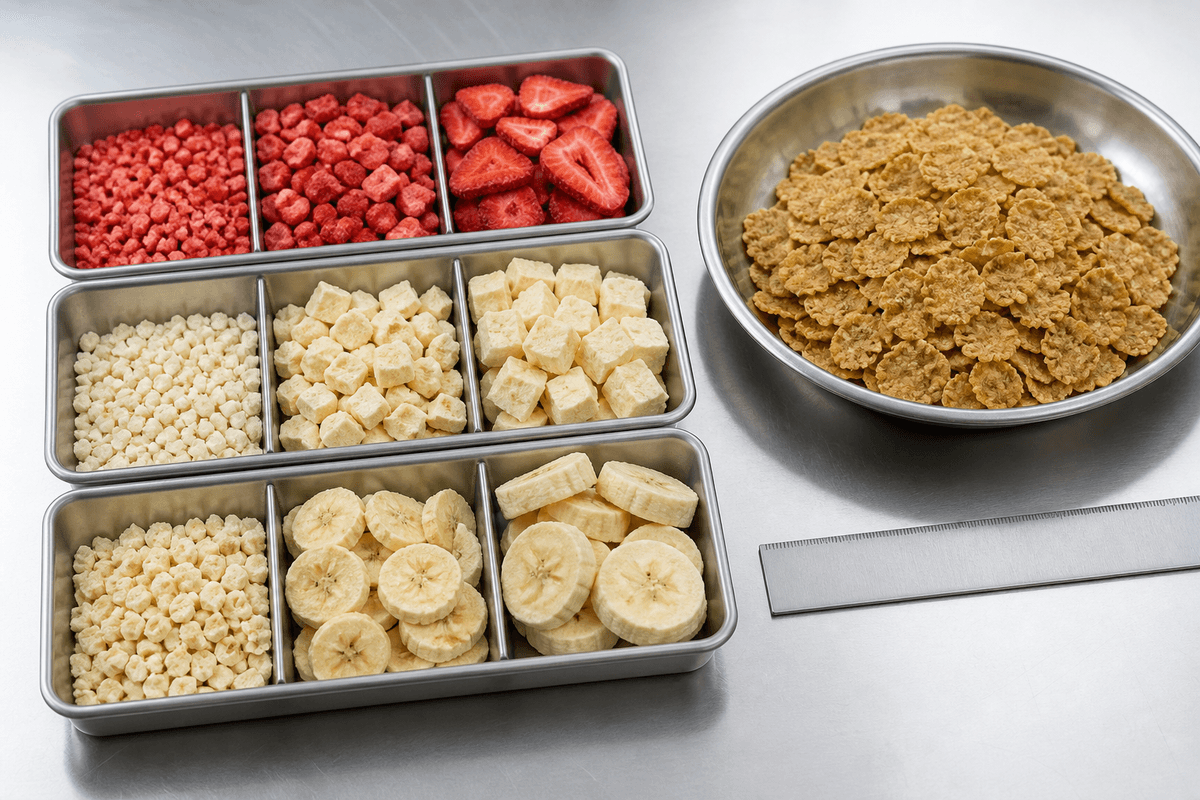
Fines are not merely cosmetic. Fruit dust can settle, tint the cereal, increase flavor intensity in some packages, and disappear from the visible inclusion claim. Define the sieve opening or particle threshold used to classify fines, then measure at receipt and after the line trial. A supplier result taken immediately after screening will not show the breakage created by export cartons, hoppers, vibratory feeders, and filling equipment.
Thin strawberry pieces deserve special attention because their bright color makes breakage easy to see. Apple and mango dices may provide more regular geometry, but they can still chip at corners. Whole or near-whole berries can reduce cut-face dust while introducing rolling and segregation behavior. The specification should reflect the chosen fruit rather than applying one generic broken-piece limit to every format.
Run A Timed Bowl Test
Test the candidate sizes in milk, yogurt, and plant-based alternatives if those uses are claimed. Observe at the expected first bite and last bite, not only after a fixed laboratory soak. Smaller pieces generally wet faster because of their higher surface-area-to-volume ratio, while large or thick pieces may remain crisp outside and firm inside. Fruit variety and internal structure can change this pattern, so direct comparison is essential.
- At filling: Record segregation, bridging, breakage, and dosing variation.
- At package opening: Compare fruit visibility and top-to-bottom distribution.
- At first bite: Check crispness, flavor release, and spoon fit.
- At last bite: Check leathery texture, excessive softening, color bleed, and bowl appearance.
- After storage: Repeat the test with finished cereal held in the intended barrier pack.
Turn The Winning Trial Into A Purchase Spec
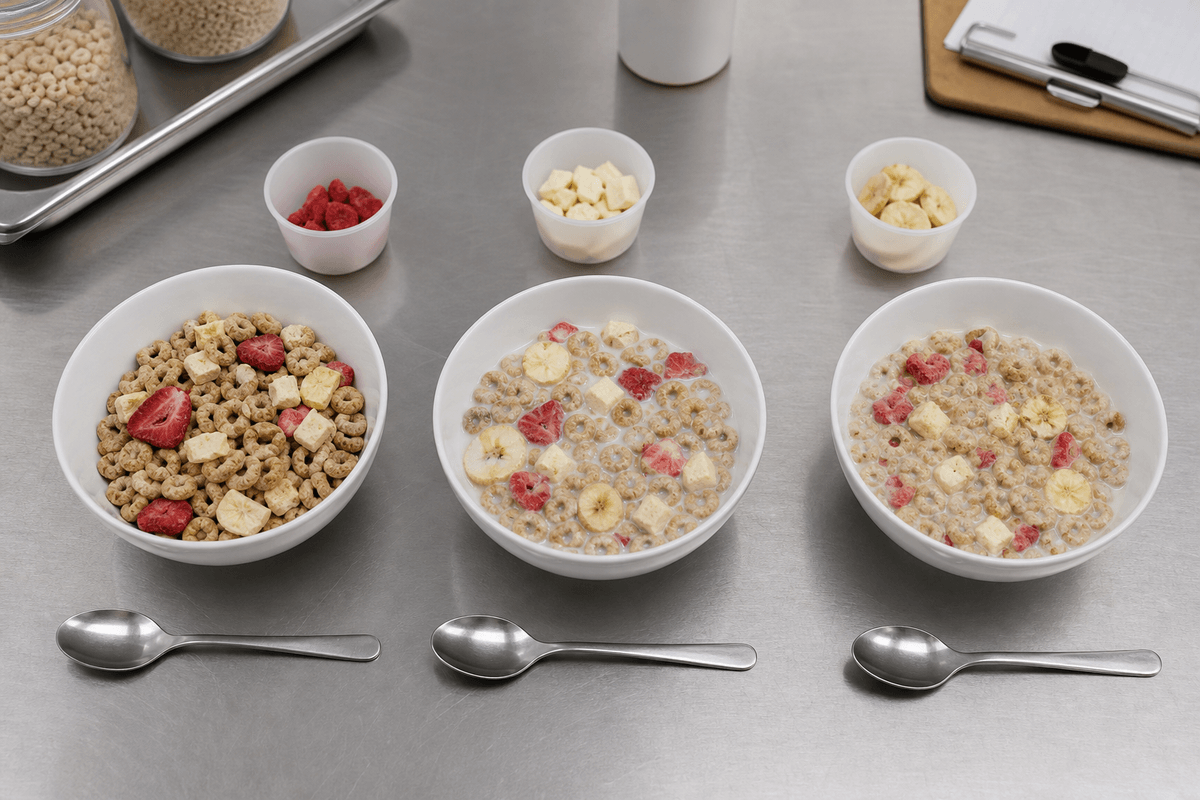
The final document should state fruit variety, shape, screen range, test method, maximum fines, broken-piece allowance, moisture or water activity limits, sensory standard, and bulk packaging. Include an approved retained sample and photographs with scale. Avoid descriptions such as "medium dice" unless the supplier and buyer share a measured definition.
Huaping Jingnan's sample-development and custom packaging process is relevant at this stage: a cereal buyer can submit the base geometry, target size bands, maximum fines, addition rate, and bulk-pack requirements for discussion. Product pages do not list every cereal-ready cut, so custom dimensions and routine availability should be confirmed rather than assumed.
Conclusion
The best fruit inclusion size for breakfast cereal is the size band that survives production and performs in the bowl. Compare three candidate bands, measure fines and segregation after vibration, run a timed eating test, and translate the winning sample into a measurable specification. That process is more reliable than selecting fruit by appearance alone.