
Natural red food coloring from fruit is not one interchangeable ingredient class. Strawberry, raspberry, blackberry, blueberry, mulberry, and red dragon fruit bring different pigment systems, fruit solids, acidity, aroma, seeds, and background color. Their appearance also changes once they enter a beverage, frosting, confection, dairy-style base, or dry mix.
The practical question is not whether a fruit powder looks red in a sample dish. It is whether an approved ingredient produces the right shade after mixing, heating, filling, light exposure, and storage in the buyer's actual product.
Start With The Shade, Not The Fruit Name
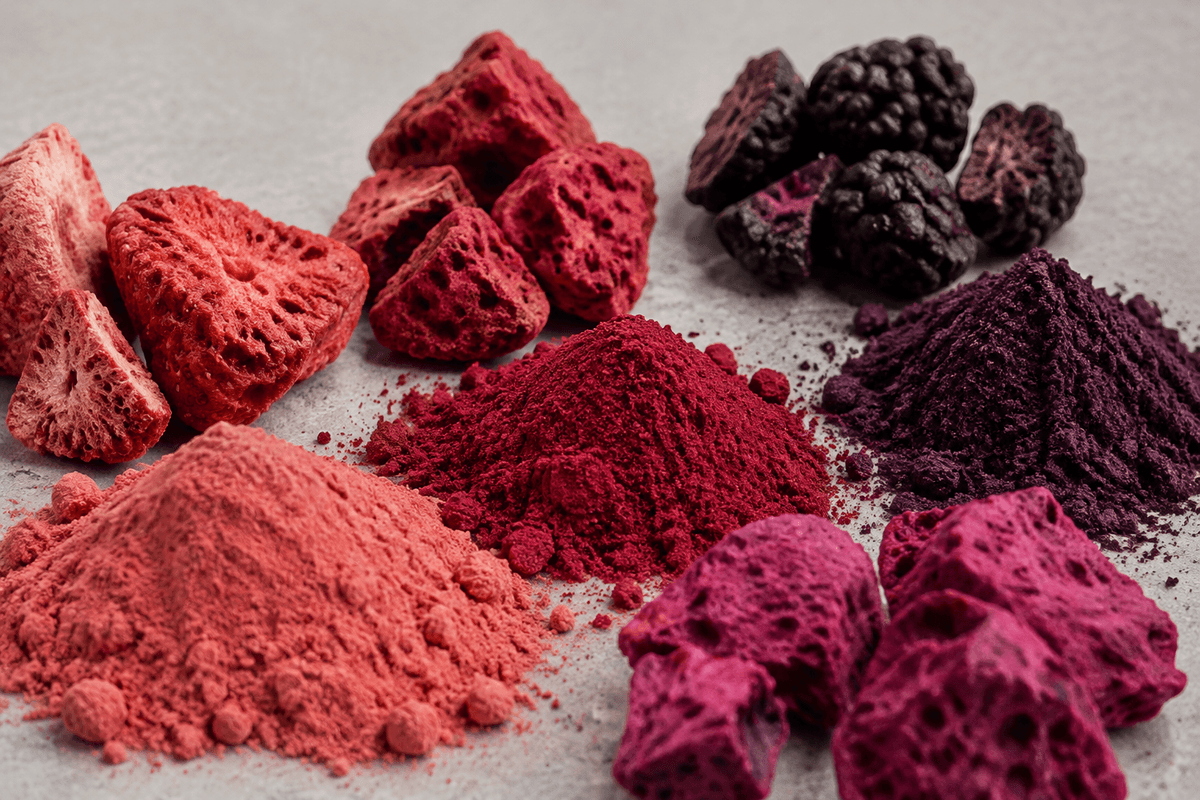
Define the target as blue-red, berry red, pink, magenta, or red-purple. Include an acceptable range and specify whether visible fruit specks are welcome. Strawberry powder may support a familiar fruit identity but can produce a softer pink-red. Dark berry powders can move toward purple. Red dragon fruit can create a vivid direction in some applications, but performance depends on its composition and process environment.
Huaping Jingnan shows strawberry, raspberry, blackberry, blueberry, and mulberry in its freeze-dried berry assortment. The individual products appear as whole berries, pieces, or slices with visibly different seed, skin, and internal structures. Those physical differences matter after milling because they influence speckle, flavor, and powder color. Exact powder availability should be confirmed.
Understand Why pH Changes Red Fruit Color
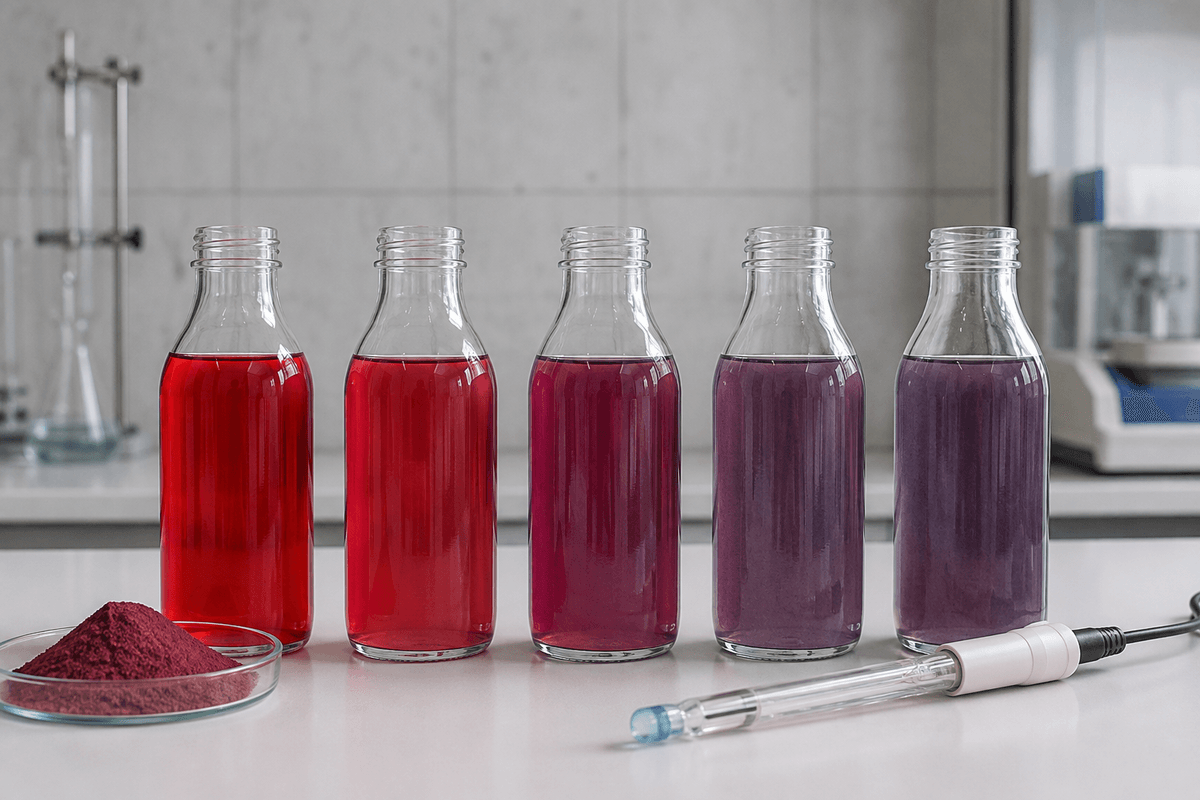
Many red and purple fruits contain anthocyanins. Their molecular form and visible shade respond to the surrounding pH. In many aqueous systems, a low pH supports a redder expression, while movement toward neutral conditions can shift or weaken color. The exact response depends on the anthocyanin profile and the complete formula, so a general pH rule cannot replace testing.
Research on anthocyanin-colored beverages also shows that temperature, light, oxygen, sugars, acids, metal ions, and other ingredients can affect stability. A developer should therefore test pH as part of a matrix, not as a single isolated variable.
Account For Opacity And Background Color
A clear drink, white frosting, oat beverage, chocolate coating, and beige protein base will not display the same dose equally. Opaque matrices scatter light and can soften color. Cocoa and whole-grain particles can mask red. Milk proteins or plant proteins may interact with fruit acids and create sediment or viscosity changes.
Test the fruit powder in the full formula before adjusting the dose. Increasing powder to overcome a dark background also increases flavor, acidity, solids, and cost. In some cases, a blend of fruit ingredients or a change in the base is more practical than simply adding more powder.
Keep Powder Form And Particle Size Consistent
A finely milled powder can create more uniform color, while a coarser product may leave attractive fruit specks. Mesh specification, particle-size distribution, seed content, peel content, moisture, and caking all affect dosing and appearance. Ask whether the powder is pure fruit or carrier-assisted and lock the approved composition.
Natural harvest variation should be managed with a numerical color range and an application standard. Compare each incoming lot in the same base, at the same dose and pH, using the same cup depth and reading time. Retain approved lots so visual and instrumental results can be reviewed together.
Evaluate Flavor At The Color Dose
Fruit-derived color is rarely sensory-neutral. Strawberry may add sweet aromatic notes, dark berries may add tart or tannic character, and dragon fruit may contribute a different flavor intensity. The color target and flavor target must be approved at the same dose. A beautiful red that forces an unwanted flavor correction is not a successful commercial solution.
- Score aroma, sweetness, tartness, bitterness, astringency, and aftertaste.
- Check whether added acid or sweetener changes color as well as flavor.
- Inspect sediment, ring formation, speckle, and surface staining.
- Repeat the test after the normal process and package hold.
- Compare at least two production lots before setting a narrow standard.
Request A Fruit-Specific Development Sample
The freeze-dried fruit portfolio includes visually distinct red, pink, yellow, and tropical fruits that can be discussed as starting materials. For a red-color project, send Huaping Jingnan the application, target hue, pH range, thermal process, preferred fruit identity, carrier restrictions, mesh requirement, and package environment.
Its sample development and custom packaging process gives buyers a route to discuss milling and pack format, but the commercial specification must be based on the approved sample and verified capabilities. Do not infer color-additive status, legal claims, or routine powder supply from a fruit image alone.
Conclusion
Natural red food coloring from fruit works best when the developer treats color as a formula outcome. Fruit identity, pigment profile, pH, heat, oxygen, background opacity, particle size, and sensory contribution all shape the result. A compact pH and process matrix reveals those interactions early and creates a much stronger basis for supplier approval and commercial scale-up.