
A clean label food coloring powder project should begin with a formulation brief, not a search for the brightest red or yellow sample. "Clean label" has no single technical definition that works for every brand, retailer, and market. One buyer may want a short ingredient statement, another may exclude artificial colors, and a third may require the coloring ingredient to contribute recognizable fruit flavor. Those are different projects.
Freeze-dried fruit powder can be useful when a developer wants fruit identity, color, acidity, and flavor in one ingredient. It also introduces natural variability, moisture sensitivity, and formula interactions. A strong brief makes those tradeoffs visible before the supplier mills samples or the application team starts a long trial series.
Define What Clean Label Means For This Product
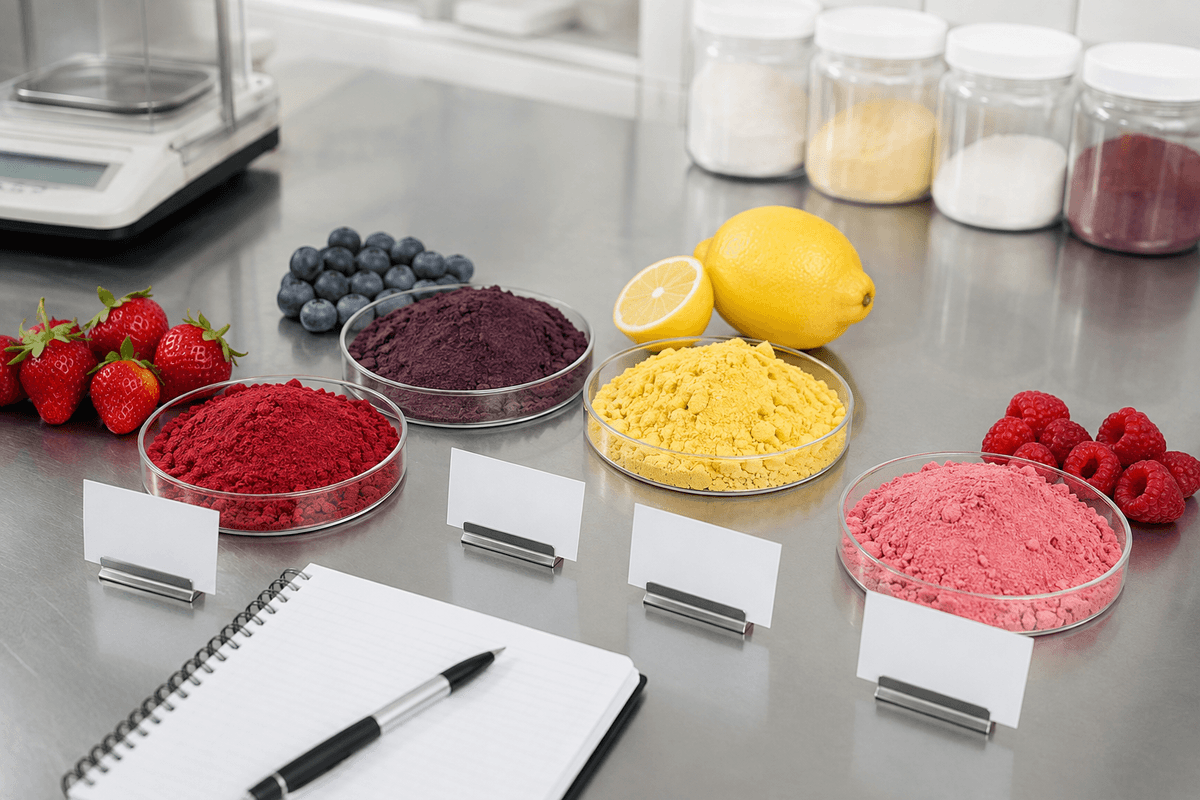
Write the rules in operational language. Name the destination market, product category, prohibited ingredients, preferred declaration, allergen policy, carrier policy, and whether the fruit must be the same fruit named on the front of pack. Do not assume that "natural," "fruit-based," and "clean label" are interchangeable regulatory terms.
FDA explains that ingredients must be listed by their common or usual names and that color additives derived from natural sources remain regulated color additives when used to impart color. The regulatory status and permitted use should therefore be reviewed for the exact material, manufacturing method, food, and market. Marketing language should follow that review rather than lead it.
Separate Ingredient Identity From Color Function
A pure freeze-dried fruit powder contains the solids of the named fruit after drying and milling. A carrier-assisted powder may include maltodextrin or another material to improve processing, flow, or stability. A concentrated coloring preparation is another category again. Each can perform differently and require a different ingredient declaration.
Ask the supplier to state the complete composition, fruit species, plant part, carrier identity and percentage when applicable, processing aids, and whether the sample is standardized by blending lots. Huaping Jingnan displays a broad selection of freeze-dried berries with naturally red and purple fruit character alongside tropical and citrus products. Powder form, composition, and project availability should be confirmed for the exact inquiry.
Control Powder Properties That Affect Factory Use
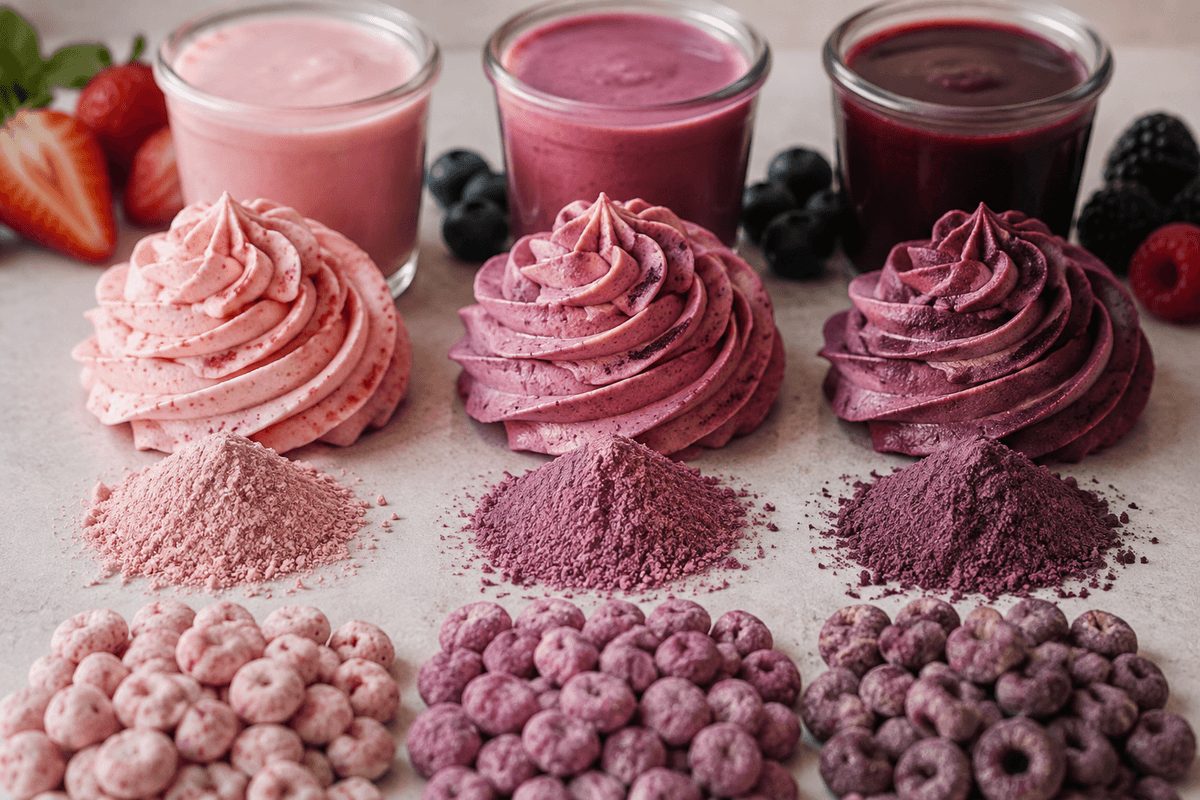
Color strength alone does not determine whether a powder works on a production line. Mesh size influences speckle and dispersion. Bulk density affects volumetric dosing. Hygroscopic powder may bridge in a hopper or cake after opening. Coarse particles may settle in a dry blend, while excessive fines can dust and create uneven dosing.
A useful specification may include composition, particle-size distribution, moisture, water activity, bulk density, flow behavior, color range, sensory profile, microbiological limits, foreign-material controls, packaging, and storage conditions. Acceptance methods must be named. "Fine powder" and "bright red" are descriptions, not reproducible limits.
Run A Dose Curve Before Optimizing The Recipe
Test at least three doses around the likely use level. Record color, flavor, acidity, sweetness balance, texture, and cost-in-use. Fruit powder can add both desired fruit notes and unwanted tartness or seed character. Raising the dose to chase color can therefore move the formula away from its sensory target.
- Prepare a control with no coloring powder.
- Use the same mixing sequence and sample depth for every dose.
- Measure immediately and after the normal process hold.
- Retain packaged samples for light, heat, and storage comparison.
- Evaluate flavor separately from visual preference.
Match Packaging To A Hygroscopic Ingredient
Freeze-dried powders can pick up moisture quickly after opening. Moisture pickup can cause clumps, poor dispersion, darker patches, and dosing variation. Confirm the liner or pouch barrier, seal integrity, pack size, headspace approach where relevant, and the factory's open-pack handling time. Smaller packs may cost more per kilogram but reduce repeated exposure during low-volume production.
Develop The Sample Around The Finished Food
Huaping Jingnan's customization workflow includes requirement submission, optional sample development, production, quality assurance, packaging, and documentation support. A useful request should identify the intended food, target shade, fruit preference, composition restrictions, trial quantity, package size, annual demand, and destination market. The visible fruit range includes yellow, orange, pink, and tropical ingredients that can support initial concept screening, while exact powder formats and performance still require confirmation.
Send the real application base or a complete formula where confidentiality procedures allow. A supplier sample that looks attractive in water may behave very differently in frosting, cereal coating, protein mix, or a high-fat filling. Buyers can use the custom fruit processing and packaging workflow to align sample format with the application rather than selecting by catalog color alone.
Conclusion
The best clean label food coloring powder is not simply the most colorful option. It is the material whose identity, declaration, shade, sensory contribution, powder behavior, process tolerance, and packaging fit the finished product. A precise brief turns an open-ended color search into a controlled development program and gives both buyer and supplier a fair basis for approving commercial lots.