
Fruit powder for natural flavoring does more than add aroma. It can also add fruit acids, sugars, fiber, pigments, seed or peel particles, and hygroscopic solids. Those contributions can make a formula feel more authentically fruity, but they can also change texture, sweetness balance, color, flow, and processing.
Product developers therefore need a useful dose window: a lower dose where the fruit is recognizable, an upper dose before negative effects become unacceptable, and a preferred operating point that remains practical across normal batch variation.
Choose The Fruit Around The Sensory Job
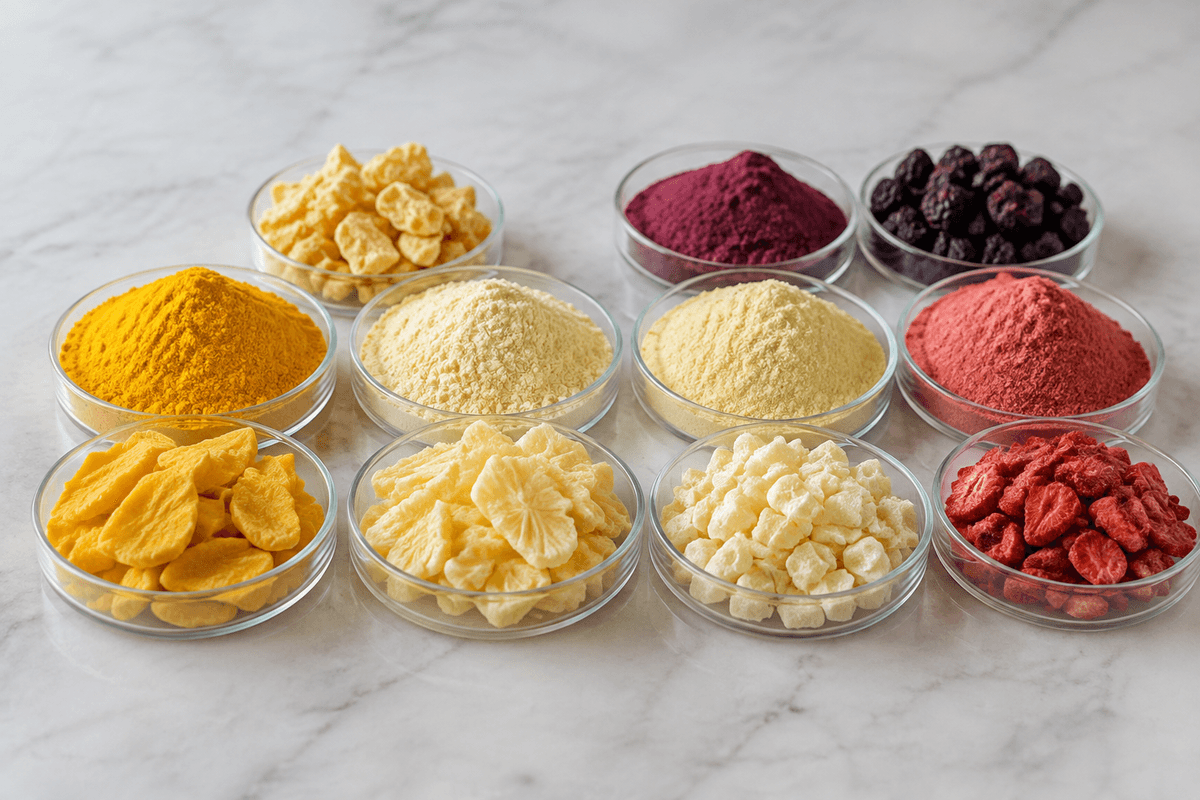
Decide whether the powder must identify a named fruit, brighten an existing flavor, provide visible fruit cues, or add a background tropical or berry note. Mango and pineapple can bring recognizable tropical character. Lemon, orange, key lime, and passion fruit can add sharp aromatic and acidic notes. Strawberry and raspberry can support both flavor and red-pink color.
Huaping Jingnan's freeze-dried fruit selection visibly spans slices, pieces, and whole-fruit formats across tropical, citrus, and orchard fruits. Its berry products add darker colors and seed-rich structures. Buyers should confirm whether a pure or carrier-assisted powder can be produced from the selected fruit and whether the flavor profile suits the application.
Describe Powder Composition Before Comparing Flavor
Two powders with the same fruit name may not be equivalent. Fruit variety, maturity, Brix, acidity, peel or seed inclusion, pretreatment, drying endpoint, milling, and carrier use can change both sensory strength and physical behavior. Request a full ingredient statement and compositional basis before running a blind comparison.
Pure fruit powder may deliver a fuller fruit-solids profile but can be more hygroscopic or difficult to flow. Carrier-assisted material may handle differently and dilute flavor per gram. Neither format is automatically better; the selection depends on declaration goals, process needs, dose, and finished-product performance.
Build A Dose Curve With A Real Control
Use the actual base formula and prepare a control plus at least three powder levels. Keep mixing energy, temperature, hold time, and sample size constant. Randomize coded samples for sensory review so the strongest color does not automatically become the perceived strongest flavor.
Score More Than Overall Liking
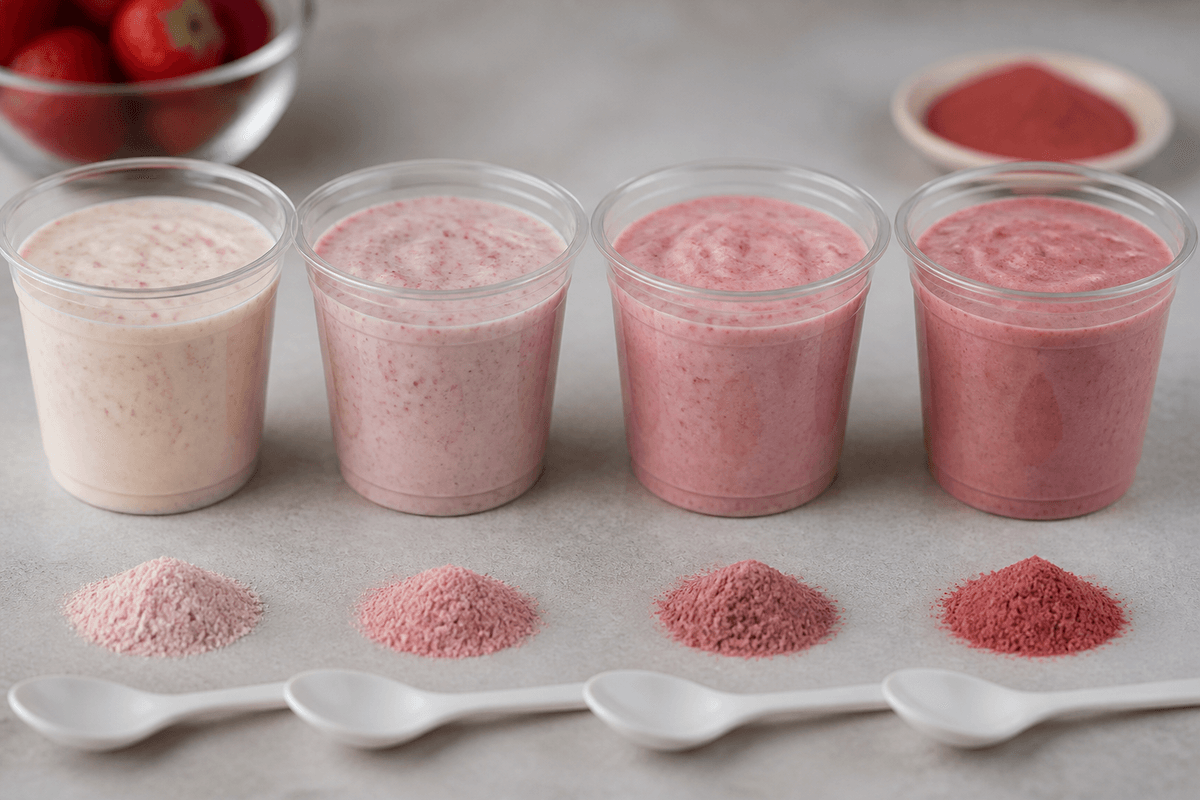
Overall preference alone does not tell the developer what to change. Score fruit identity, aroma intensity, sweetness, tartness, bitterness, astringency, cooked notes, aftertaste, color fit, and texture. In a beverage, also inspect sediment and ring formation. In a bar or coating, check grit, binding, and moisture migration.
- Evaluate the freshly mixed sample and the post-process sample.
- Repeat sensory review after the normal package hold.
- Record whether the fruit note appears early, late, or only in aroma.
- Compare at least two powder lots at the chosen use level.
- Calculate cost per finished unit, not powder price alone.
Match Mesh Size To The Eating Experience
Fine powder usually disperses more evenly and releases flavor quickly, but it may dust and cake. Coarser granules can provide visible fruit and bursts of flavor, yet they may settle in a dry mix or feel gritty in a smooth beverage. A product may use both: fine powder for background flavor and small fruit pieces for visual identity.
Specify mesh or particle-size distribution, moisture, water activity, bulk density, flowability, and fines. In dry blends, perform a segregation test after vibration and transport simulation. In wet systems, measure dispersion time and observe sediment after a realistic hold.
Protect Volatile Flavor During Processing
Mixing order matters. Adding powder before a strong heat step may reduce fresh top notes. Adding it late may improve aroma but create dispersion or microbiological control questions. High shear can break visible fruit particles, while long exposure to humid production air can create clumps before dosing.
Run the complete process at pilot scale, including blending, heating or baking, cooling, filling, and packaging. Compare aroma immediately after processing and at the end of expected storage. The best bench-top dose may need adjustment after volatile loss or flavor equilibration.
Use Packaging As Part Of Flavor Control
High-barrier packaging and prompt sealing help protect dry powder from moisture and oxygen. Pack size should match the factory's use rate so an opened bag is not repeatedly exposed. For finished products, package oxygen, light transmission, seal quality, and headspace can influence fruit aroma and color over time.
Prepare A Development Request That Can Be Answered
Huaping Jingnan's custom processing and sample development service can be approached with a specific fruit, application, target dose range, desired mesh, carrier restriction, package size, destination market, and documentation list. Product images can help shortlist fruit formats, but they do not establish a powder specification.
Ask for representative samples and a product specification before scale-up. The final agreement should cover composition, sensory reference, particle size, moisture controls, microbiological criteria, packaging, lot identification, and change notification. A useful flavor window is easier to maintain when the physical powder is controlled as carefully as the taste.
Conclusion
Fruit powder for natural flavoring succeeds when developers treat it as a multifunctional food ingredient. A controlled dose curve shows where fruit identity becomes clear and where acidity, color, texture, handling, or cost becomes limiting. That window gives procurement, R&D, quality, and the supplier one practical target for commercial production.