
How to store freeze-dried fruit after opening depends on what happens during the next production shift, not only on a warehouse temperature statement. Freeze-dried fruit is porous and hygroscopic. Once its high-barrier liner is opened, room humidity, wet tools, repeated scooping, warm-cold movement, and weak temporary closures can change texture and water activity long before visible spoilage appears.
A practical factory SOP should minimize the time the ingredient is exposed, preserve the original lot identity, and define when an opened remainder can be reused. "Keep sealed in a cool, dry place" is not enough for a bulk carton that may be opened several times across multiple shifts.
Condition The Sealed Pack Before Opening
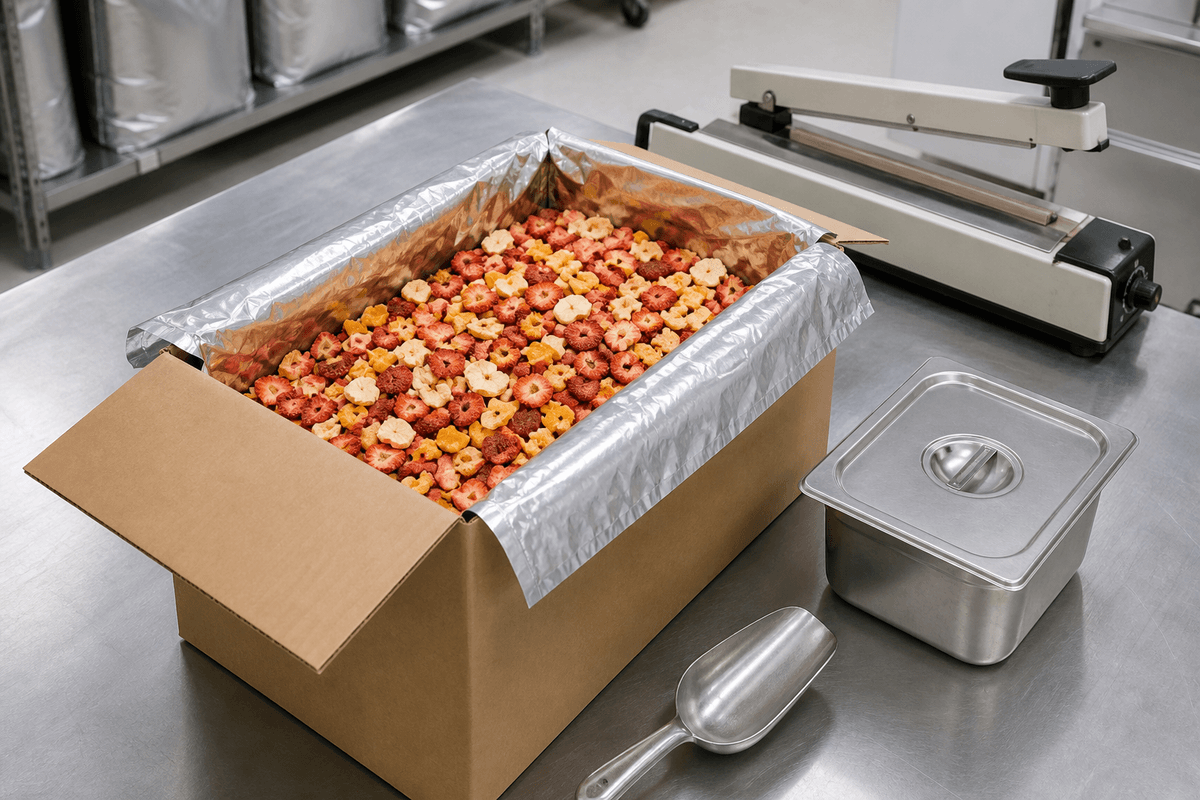
If product arrives from a cold warehouse or vehicle, keep the liner sealed while it approaches the processing-room temperature. Opening a cold pack in humid air can create condensation on the ingredient or inside the liner. The same caution applies when moving product between air-conditioned and warm areas. Record room temperature and relative humidity where opened fruit is staged.
Inspect the carton and liner before use. Check punctures, damaged seals, loose closures, unexpected soft pieces, odor, and excessive fines. If the pack condition differs from the approved state, quarantine it rather than mixing it into a new batch and losing the evidence.
Open Only A Working Quantity
Divide the shift requirement into smaller working containers instead of leaving the full liner open beside the line. Each container should be clean, dry, food-grade, closable, and identified with the source lot. Keep the reserve quantity inside the original high-barrier liner and close it immediately after dispensing.
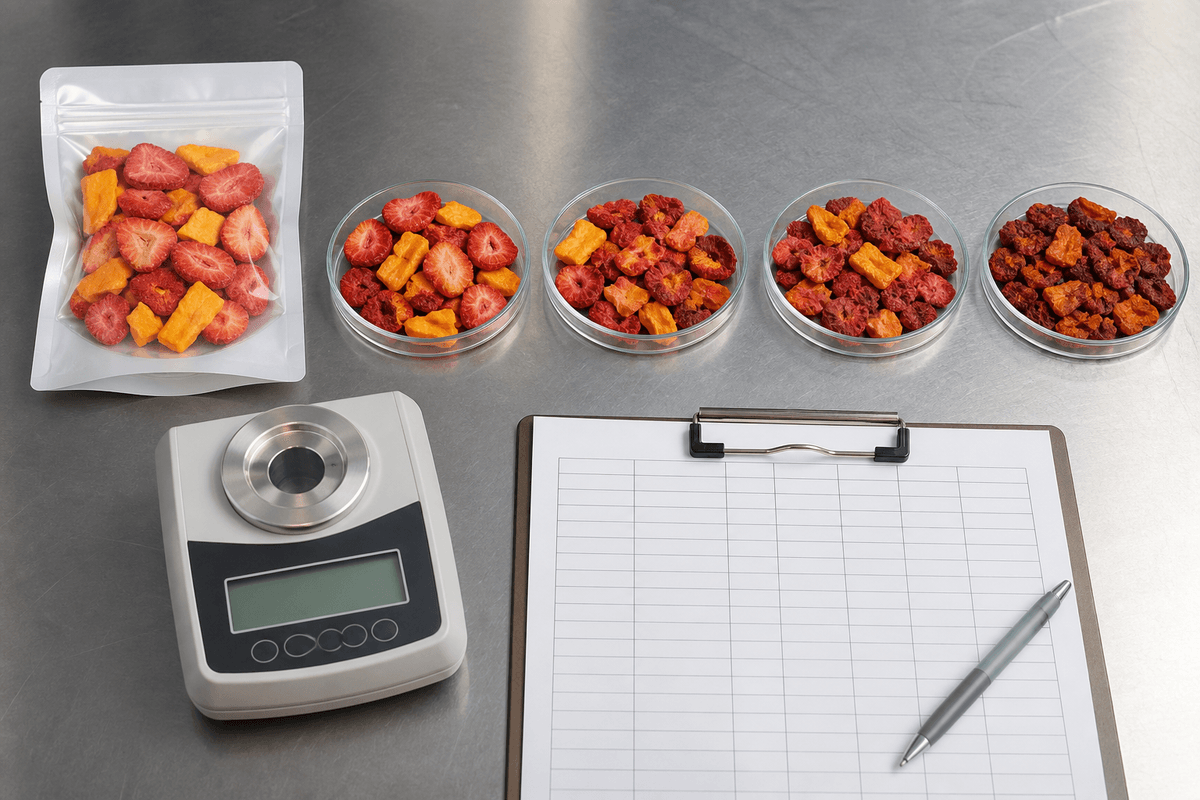
Huaping Jingnan's fruit range includes delicate formats that respond differently to repeated handling. Broad strawberry slices expose a large porous surface and show softening quickly. Small apple or mango pieces can be portioned efficiently but create more exposed cut area per kilogram. Blueberries and compact berries may resist edge breakage better, yet still absorb humidity through their porous structure. The SOP should be validated with the purchased format rather than copied from another fruit.
Reseal With A Moisture Barrier, Not A Fold Alone
A folded liner held by the carton flaps is not a reliable moisture closure. Use the pack supplier's validated heat seal, zipper, clamp, or equivalent full-width closure. Avoid trapping fruit dust in the seal zone. If the original liner cannot be resealed effectively, transfer the remainder to an approved high-barrier bag of suitable size and retain the original identification.
A domestic zipper bag or open plastic tote may be convenient but should not be assumed to provide the required water-vapor barrier. Packaging research on dried fruit emphasizes the need for protection against water vapor and, depending on the product, oxygen and volatiles. The correct structure depends on exposure duration, climate, fruit format, and quality target.
Do Not Add Desiccant By Habit
A desiccant may be useful in a validated pack system, but it is not a substitute for fast handling and a sound closure. Its capacity, food-contact suitability, placement, ingestion control, and effect on the product must be assessed. Do not place loose desiccant directly among fruit pieces. Oxygen absorbers address a different mechanism and also require packaging compatibility and validation.
Set A Tested Open-Life Limit
Do not invent a universal number of days. Establish open life through a controlled study at the actual room conditions. Open and close the pack using the expected frequency, tools, and working-container practice. At selected intervals, compare crispness, water activity, moisture, fines, color, odor, and application performance with an unopened control.
Freeze-drying reviews note that porous freeze-dried foods can reabsorb moisture rapidly and benefit from prompt high-barrier packaging. The study should therefore include short exposure events, not only long storage. Five ten-minute openings can behave differently from one continuous fifty-minute opening because each event introduces fresh humid air and handling.
Keep Traceability Intact
- Never merge lots casually: An opened remainder should retain its original lot and status.
- Record remaining weight: This supports inventory control and identifies unexplained exposure or loss.
- Use first-opened, first-used logic: Apply it only to material that still meets the release criteria.
- Quarantine uncertain material: Softness, a damaged liner, missing identification, or wet tools requires review.
- Retain a comparison sample: An unopened or protected sample helps distinguish lot variation from handling damage.
Specify Packaging Around The Plant's Use Pattern
Pack size is part of moisture control. A 10 kg liner may be efficient for a continuous cereal line but unsuitable for a pilot line using 1 kg per day. Smaller inner packs reduce repeated exposure but increase packaging use and handling. Huaping Jingnan's bulk and custom packaging options give buyers a place to discuss liner size, unit weight, retail or bulk format, and sample development around actual daily consumption.
Conclusion
Store opened freeze-dried fruit by controlling exposure, not by relying on a vague dry-place instruction. Condition sealed packs before opening, portion only a working quantity, use dry tools, reseal with a real barrier closure, preserve lot identity, and establish open life through water activity and application testing. The best pack size is the one the plant can consume without repeated uncontrolled opening.