
Freeze-dried fruit in chocolate can deliver bright color, concentrated flavor, and crisp contrast, but the combination is sensitive to moisture. The question is not simply whether the fruit has a low moisture percentage. Moisture migration is driven by differences in water activity and affected by temperature, time, exposed surface area, coatings, package barrier, and any higher-moisture filling sharing the product.
When the system is poorly matched, fruit can lose crispness, chocolate can develop a rough surface or sugar bloom after moisture exposure, and fruit-chocolate interfaces can weaken. The correct development approach is to measure each component, control the assembly environment, and test the complete confection under realistic storage cycles.
Water Activity Predicts Direction Better Than Moisture Content

Moisture content describes how much water is present. Water activity describes how available that water is and relates to vapor pressure at equilibrium. Two ingredients can have similar moisture contents but different water activities because their solids bind water differently. In a closed package, water tends to move from the component with higher water activity toward the component with lower water activity until the system approaches equilibrium.
Measure the chocolate, fruit, fillings, wafers, nuts, and any intermediate layer separately. Then measure the assembled product during storage. FDA guidance describes water activity as a ratio of food vapor pressure to that of pure water at the same conditions. For confectionery development, the practical lesson is that a moisture percentage alone cannot establish compatibility.
Map Every Moisture Route
| Route | Likely Symptom | Development Check |
|---|---|---|
| Room air into exposed fruit | Soft fruit, reduced snap, or sticking before enrobing. | Time open packs and track room humidity plus fruit water activity. |
| Higher-aw filling into fruit or chocolate | Local softening, interface failure, or surface change. | Measure components separately and test the complete layered system. |
| Ambient humidity through packaging | Gradual loss of crispness across the pack. | Compare high-barrier and control packs under warm-humid storage. |
| Condensation from temperature cycling | Spotting, sugar bloom, sticky zones, or package fogging. | Run distribution cycles and inspect after returning unopened packs to room temperature. |
Fruit Format Changes The Interface
Powder, small dice, berry pieces, and whole pieces expose different surface areas. Powder disperses flavor and color through the chocolate but introduces a large interface and can thicken the chocolate mass depending on particle size and composition. Small dices give repeatable dosing and a high piece count, yet they have more cut surface per kilogram. Large pieces create a premium visual center but may trap voids during enrobing and receive uneven coating.
Huaping Jingnan's berry range is especially relevant to chocolate concepts because strawberry, raspberry, blackberry, mulberry, and blueberry formats provide distinct red, purple, and blue color cues. From the product images, sliced strawberries offer broad visible faces for bark and tablets, while compact berries or smaller berry pieces suit clusters and centers. Exact cut, powder availability, and chocolate-ready screening should be confirmed through samples.
Protect Fruit Before And During Enrobing
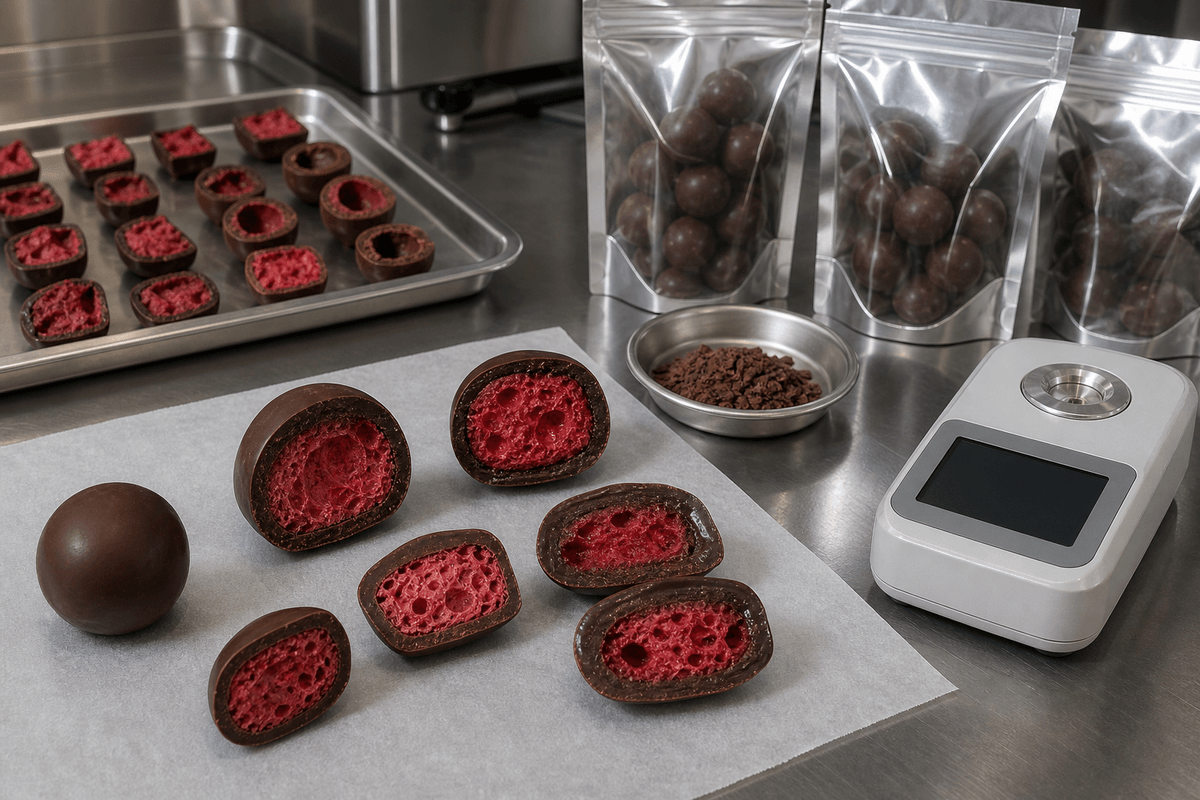
Open only the amount the line can use within a controlled time. Keep reserve product sealed, avoid staging fruit beside washdown activity, and use dry tools and closed bins. If fruit warms or cools substantially relative to the room, allow sealed packs to equilibrate before opening so humid air does not condense on cold product.
A continuous chocolate coating can slow moisture exchange, but it should not be treated as a perfect vapor barrier. Coverage, pinholes, piece geometry, and storage temperature all matter. A compatible pre-coat or fat-based barrier may help in layered products, but it must be evaluated for adhesion, flavor, labeling, and processing. The solution should address the entire formulation rather than masking a high-water-activity filling.
Separate Moisture Failure From Tempering Failure
Chocolate bloom has more than one cause. Sugar bloom is associated with moisture dissolving surface sugar and recrystallization after drying. Fat bloom is more closely linked to fat migration, crystal form, temper, and temperature history. A white or dull surface should therefore trigger a structured investigation: inspect the location, check water exposure, review temper records, and compare storage conditions. Do not assign every surface defect to the fruit.
Temperature can influence migration as well as chocolate structure. Research on chocolate films and heat-resistant chocolate reports faster water-vapor transmission at higher temperatures in some systems. A shelf-life program should include the warm conditions that may occur during distribution, not only a stable laboratory cabinet.
Build A Shelf-Life Matrix
- Baseline: Record component water activity, fruit texture, chocolate snap, and interface appearance.
- Packaging comparison: Test the intended film against a known high-barrier control.
- Temperature cycle: Include realistic warm transport and return-to-room-temperature conditions.
- Layered comparison: Test fruit in plain chocolate and in the complete product with fillings or wafers.
- Destructive inspection: Cut samples open to inspect hidden voids, local softening, and coating coverage.
Write An Ingredient Specification For Confectionery
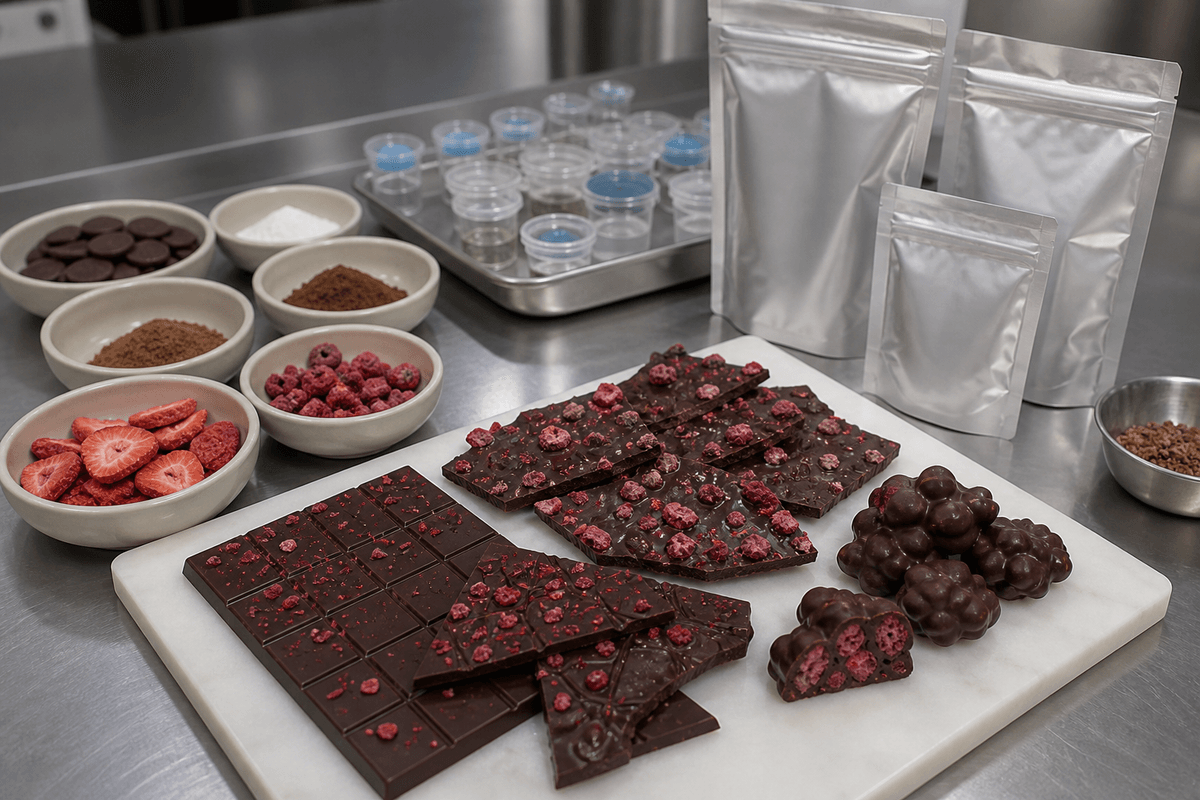
Specify fruit type, format, particle range, fines, moisture, water activity, sensory profile, microbiological limits, and high-barrier bulk packaging. Add a maximum open exposure time for the plant trial. If the formula needs a powder, confirm whether it is pure fruit or contains a carrier, because that distinction affects viscosity, ingredient labeling, and water sorption behavior.
Huaping Jingnan's custom sample and packaging service can support a confectionery inquiry built around actual geometry: tablet, bark, cluster, center, or powder blend. Buyers should provide the chocolate type, fruit format, target piece count, line exposure time, pack structure, and shelf-life conditions so that sample development addresses the real moisture interfaces.
Conclusion
Moisture migration in freeze-dried fruit chocolate products is a system problem. Measure water activity, map every moisture route, control open handling, select a suitable fruit format, and validate the complete confection under realistic temperature and packaging conditions. Good chocolate coverage helps, but stable performance comes from compatible components and a verified process.