
Freeze-dried fruit powder vs fruit pieces is not a simple question of stronger flavor versus better appearance. Powder distributes fruit solids across a formula; pieces create discrete fruit events. The correct format depends on where the ingredient must travel, how the finished product is processed, and what the consumer should see and feel.
A bakery batter may benefit from powder for uniform color but need pieces for visible identity. A cereal may use pieces as a premium inclusion while using a small amount of powder in a coating. A beverage may require powder that disperses without sediment. Many products work best with a deliberate combination rather than forcing one format to perform both jobs.
Powder Spreads Function Through The Formula
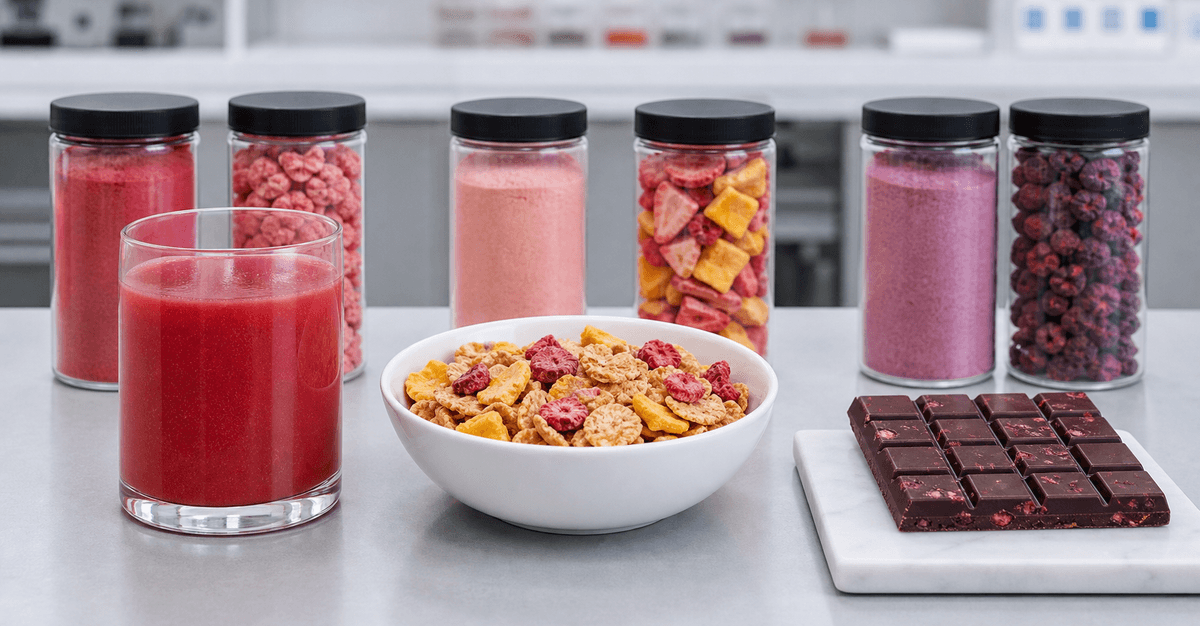
Powder provides high surface area and more uniform distribution. It can deliver color and flavor to coatings, dry beverage blends, fillings, seasoning systems, doughs, and nutrition mixes. Its performance depends on mesh, fruit composition, carrier status, bulk density, flowability, and dispersibility. Fine powder is easy to dose in small amounts but can create dust, cling to equipment, absorb humidity quickly, and agglomerate.
Ask whether the powder is milled from whole freeze-dried fruit or produced from juice or puree with a carrier. A fruit powder containing maltodextrin or another carrier is not equivalent to a pure milled fruit powder. The difference affects ingredient declaration, fruit-solids contribution, sweetness, color, flow, and cost-in-use.
Pieces Create Visible Fruit Identity
Pieces preserve recognizable shape and give the consumer separate bursts of flavor and texture. They suit cereal, granola, chocolate bark, snack mixes, bakery inclusions, yogurt toppings, and premium dry mixes. Their main variables are cut geometry, piece strength, fines, bulk density, segregation, and rehydration behavior.
Huaping Jingnan's product range illustrates why piece format matters. Strawberry slices show a recognizable red cross-section for toppings and chocolate. Apple, banana, mango, pineapple, and dragon fruit can be considered for dices or chunks where controlled spoon fit is important. Blueberry, raspberry, blackberry, and mulberry formats create a berry identity that powder cannot reproduce visually. Exact shapes and cut sizes should be confirmed with commercial samples.
Do Not Compare Price Per Kilogram Alone
Compare cost at the dosage that meets the product target. Powder may achieve color at a low inclusion rate but require dust control, slower feeding, or an anti-caking strategy. Pieces may command a higher unit price yet support a visible premium claim at a modest serving dose. Breakage losses, sieve rejects, line downtime, and package barrier also belong in the cost model.
For powder, calculate the actual fruit solids delivered when a carrier is present. For pieces, calculate usable yield after fines and broken material. A low-priced ingredient can become expensive if only part of the delivered material meets the application specification.
Test The Format In The Real Process
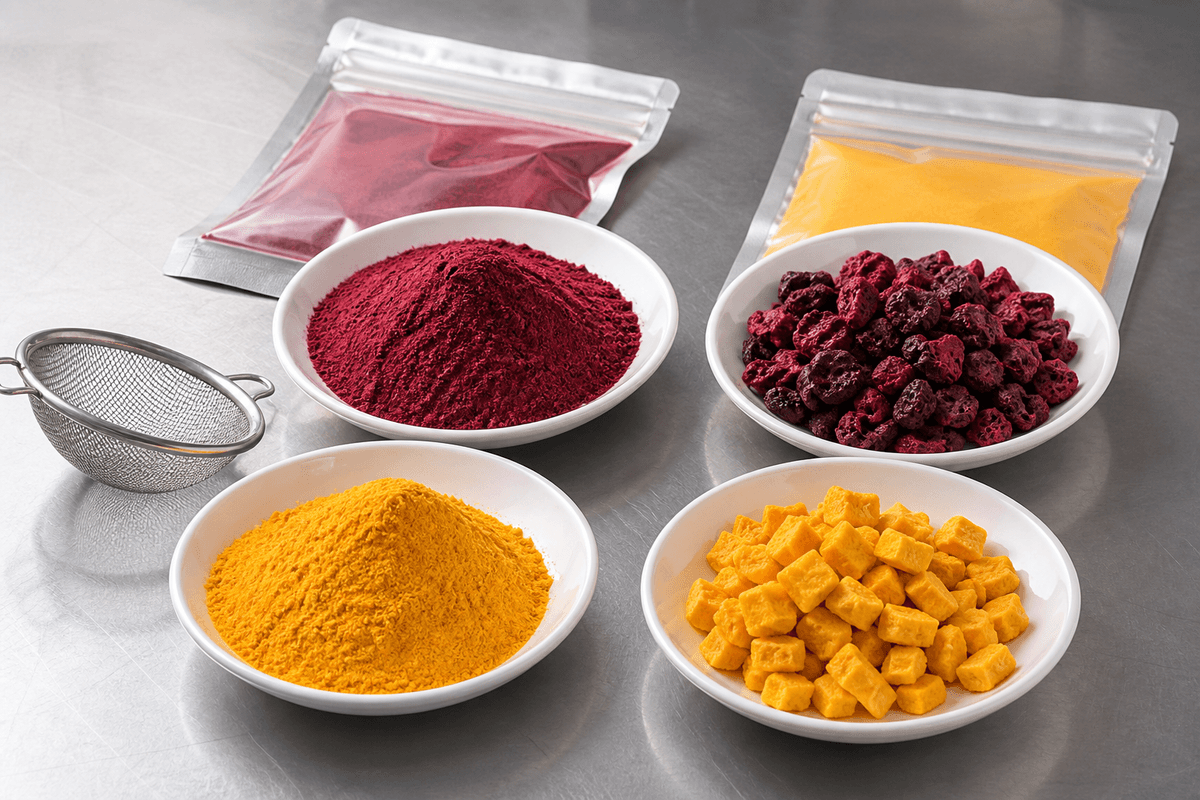
Powder trials should measure flow through the intended feeder, dust generation, color distribution, flavor uniformity, dispersibility, and any effect on viscosity or dough water demand. Piece trials should measure breakage through hoppers and mixers, segregation after vibration, visibility, and texture after the expected heat or hydration step.
- Dry beverage: Compare dissolution, suspension, sediment, color ring, and flavor after standing.
- Cereal or granola: Compare piece count, fines, segregation, and bowl texture.
- Chocolate: Compare viscosity for powder and coating coverage for pieces.
- Bakery: Compare powder color uniformity with piece survival and moisture pockets.
- Yogurt topping: Compare powder color bleed with piece softening over serving time.
A Hybrid Format Can Solve Two Jobs
Using both formats can be technically sensible. Powder can build the base flavor and color, while selected pieces create visible fruit identity. The combination can also reduce dependence on large pieces for flavor delivery. However, it introduces two handling systems and two specifications. Developers should confirm that the powder does not coat the pieces, increase dust, or obscure their appearance.
Ask For Format-Specific Documents
Both formats need ingredient identity, allergen status, microbiological criteria, moisture or water activity, lot traceability, and packaging details. Powder additionally needs mesh distribution, carrier declaration, and flow or dispersibility methods. Pieces need dimensional tolerance, fines definition, broken rate, and retained photographs with scale.
Huaping Jingnan's sample-development service can be used to compare a selected fruit as pieces, a milled format, or a combined concept. Because the website does not list every fruit powder as a standard item, buyers should confirm powder feasibility, ingredient composition, mesh, MOQ, and routine availability before building a formula around it.
Conclusion
Choose freeze-dried fruit powder when the formula needs distributed color and flavor; choose pieces when it needs visible fruit and texture. Then test the format's real weaknesses: flow and clumping for powder, breakage and segregation for pieces. A hybrid can work well when each format has a clearly defined job.