
Freeze-dried powder vs spray-dried powder cannot be decided from the drying method name alone. The feed material may be whole fruit, puree, juice, concentrate, or extract. Carriers and wall materials may be added before drying. The powders may then be milled, agglomerated, sieved, or blended. These choices can matter as much as the dryer when the buyer evaluates flavor, color, solubility, flow, labeling, and cost.
Freeze-dried powder is often selected for a strong whole-fruit story and low-temperature processing. Spray-dried powder is often selected for scalable production, controlled particle formation, and beverage functionality. Neither is automatically purer, more soluble, more nutritious, or more economical in every fruit system.
The Processes Start With Different Physical Problems
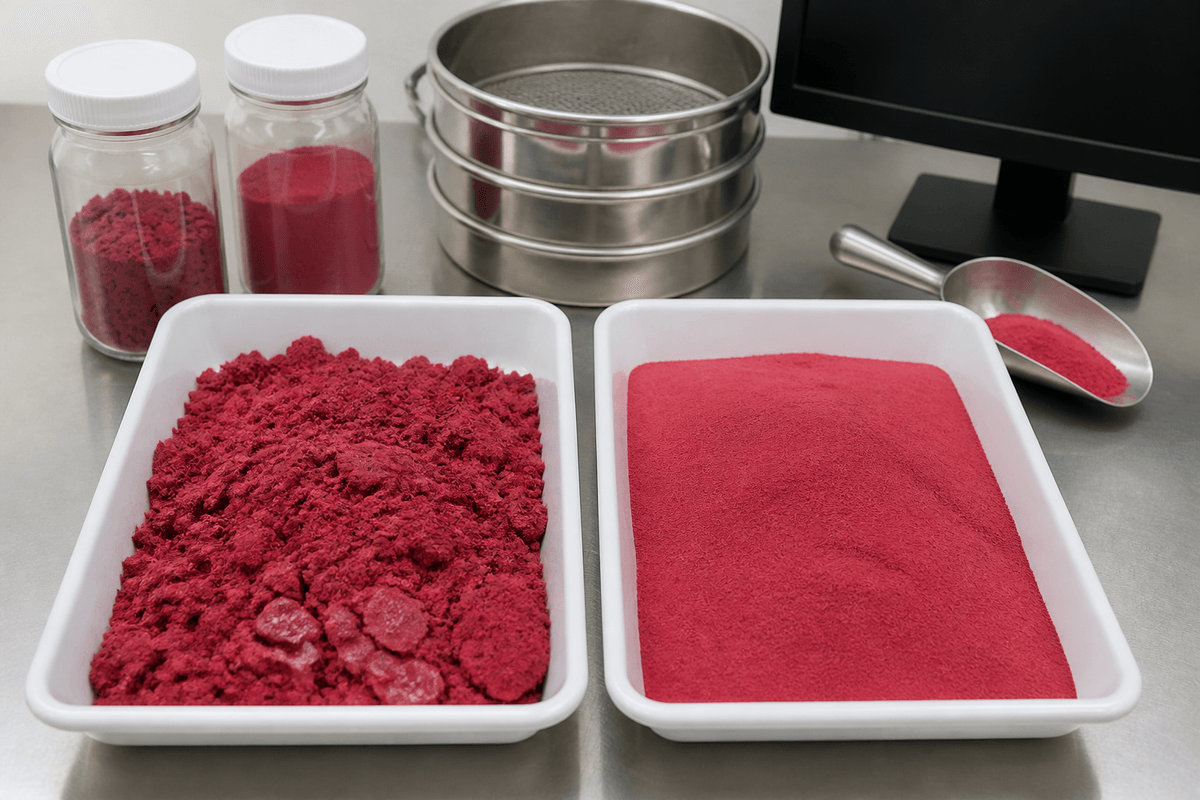
Freeze-drying freezes the product and removes ice by sublimation under reduced pressure, followed by secondary drying to lower bound moisture. If a porous freeze-dried fruit is milled, the resulting particles can retain irregular shapes and high surface area. Spray drying atomizes a liquid feed into hot drying gas; droplets dry rapidly into small particles. A carrier is commonly used for sticky, sugar-rich fruit feeds, but its type and amount vary.
Temperature exposure should be described accurately. Spray drying uses hot inlet air, yet the droplet temperature and exposure time differ from the inlet temperature. Freeze-drying uses low product temperatures but can involve long cycles and subsequent milling. Buyers should request actual process and composition information rather than treating "hot" and "cold" as complete quality explanations.
Quality Results Are Fruit- And Formula-Specific
Published comparisons do not support one universal winner. A study of haskap berry juice powders found spray drying competitive with freeze drying for several quality outcomes, while carrier selection strongly influenced results. A review of polysaccharide carriers reported cases where freeze drying retained more anthocyanins, but the outcome depended on the fruit system and wall material. A citrus powder comparison found method-specific differences in solubility, oil absorption, color, aroma, and composition.
The buyer should therefore avoid claims such as "freeze-dried always retains more nutrients" unless the exact powders and analytes have been compared. Define which compounds or sensory attributes matter, use the same fruit-solids basis, and test samples with documented feed composition.
Application Performance Can Reverse The Choice
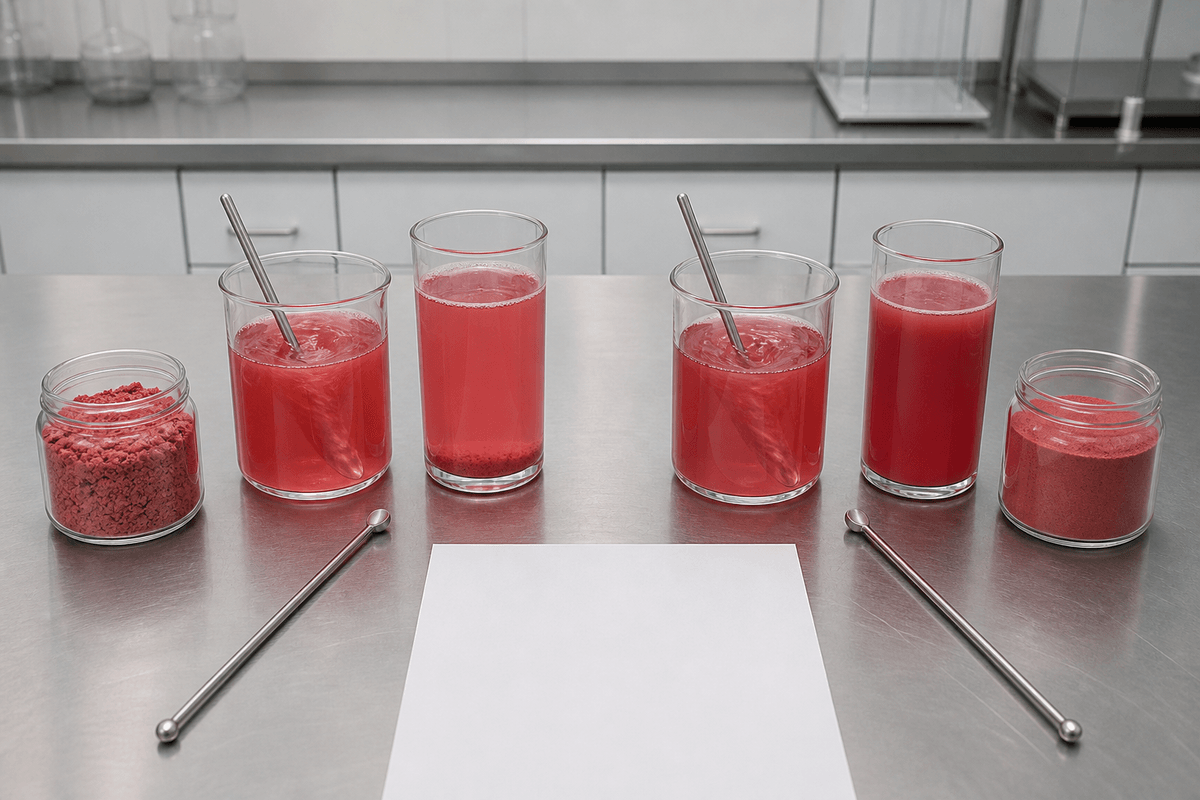
A freeze-dried powder may deliver an appealing fruit aroma and whole-fruit color but disperse slowly or leave sediment in a clear beverage. A spray-dried powder may dissolve more readily yet require a higher dosage to reach the same fruit intensity because of carrier dilution. In a bakery filling, rapid solubility may matter less than heat-stable color. In a seasoning, flow and adhesion may outweigh beverage clarity.
- Beverages: Test wetting, dissolution, sediment, foam, color ring, and flavor after standing.
- Powder blends: Test segregation, dust, caking, bulk density, and feeder consistency.
- Bakery and bars: Test flavor after heat, dough or binder interaction, and color stability.
- Chocolate and coatings: Test viscosity, particle perception, and moisture compatibility.
- Label-driven products: Compare carrier declaration and fruit-solids contribution at the use rate.
Calculate Cost Per Functional Result
Spray drying can offer efficient continuous production, while freeze drying is typically more time- and energy-intensive. That does not mean the lower price per kilogram always gives the lower finished-product cost. Normalize quotations by fruit solids, required dosage, line yield, dust loss, rework, packaging, and shelf-life performance.
A powder that costs more but reaches the sensory target at half the dosage may be competitive. Conversely, a premium freeze-dried powder may not justify its cost when the application masks its aroma or filters out insoluble fruit solids. A small application trial is more informative than a generic method comparison.
Verify What The Supplier Actually Makes
Huaping Jingnan presents freeze-dried fruits including mango, apple, banana, pineapple, citrus, dragon fruit, and berry options that can serve as starting materials for milled-powder discussions. The visible product range supports whole-fruit identity and color variety, but the website does not establish that every fruit is routinely supplied as a powder or that spray-dried products are part of the standard range.
Use the company's custom development process to ask about powder feasibility, feed material, carrier status, mesh, water activity, packaging, MOQ, and sample testing. If the project requires spray-dried powder, confirm that capability and specification explicitly rather than inferring it from a freeze-dried fruit page.
Conclusion
Freeze-dried and spray-dried powders are process families, not complete product specifications. Compare feed material, carrier, fruit-solids content, particle properties, sensory performance, and cost at the real use rate. The best powder is the one that meets the finished-product target with a transparent composition and a repeatable commercial specification.