
A freeze dried fruit moisture content specification should do more than place one percentage on a product sheet. It must identify the product format, test method, sampling point, sample preparation, units, acceptance rule, and pack condition. Without those details, a supplier and buyer can test the same lot and obtain results that are difficult to compare.
The right moisture requirement also depends on use. Strawberry pieces intended for a cereal blend are judged by breakage and bowl texture as well as analytical moisture. Apple dice for instant oatmeal need controlled rehydration. Fruit powder for a beverage or bakery formula may require flowability, caking, mesh, and dispersibility checks. The moisture result is useful only when it is connected to these application risks.
Moisture Is A Method-Dependent Result
Before setting a limit, buyers should agree how the value will be measured. Oven methods, vacuum methods, moisture analyzers, and other validated approaches may not produce identical results for every fruit matrix. Sugars, acids, volatile compounds, particle size, and sample handling can influence what the method records as mass loss. The specification should therefore name the method or an agreed equivalent and define how disagreements will be resolved.
Sampling matters just as much. A large bulk pack can contain intact pieces, small fragments, and fines. Powder can settle during transport. The laboratory portion should represent the lot and should be protected from room humidity while it is prepared. Record whether the sample was taken after drying, after screening, from the finished pack, or at receiving, because each point answers a different question.
Separate Moisture Content From Water Activity
Total moisture describes how much water is measured by the selected method. Water activity describes the water available in equilibrium with the surrounding headspace. FDA explains that water activity is related to equilibrium relative humidity and that temperature control is important during measurement. Two fruit products can have similar total moisture results but behave differently because their composition and water binding are different.
For this reason, a buyer should not use moisture and water activity as interchangeable terms. Moisture may be the primary release item for one product, while a topping, powder, or high-barrier pack project may benefit from both values. Each value needs its own method, units, and acceptance rule.
Check The Product After Packaging And Handling
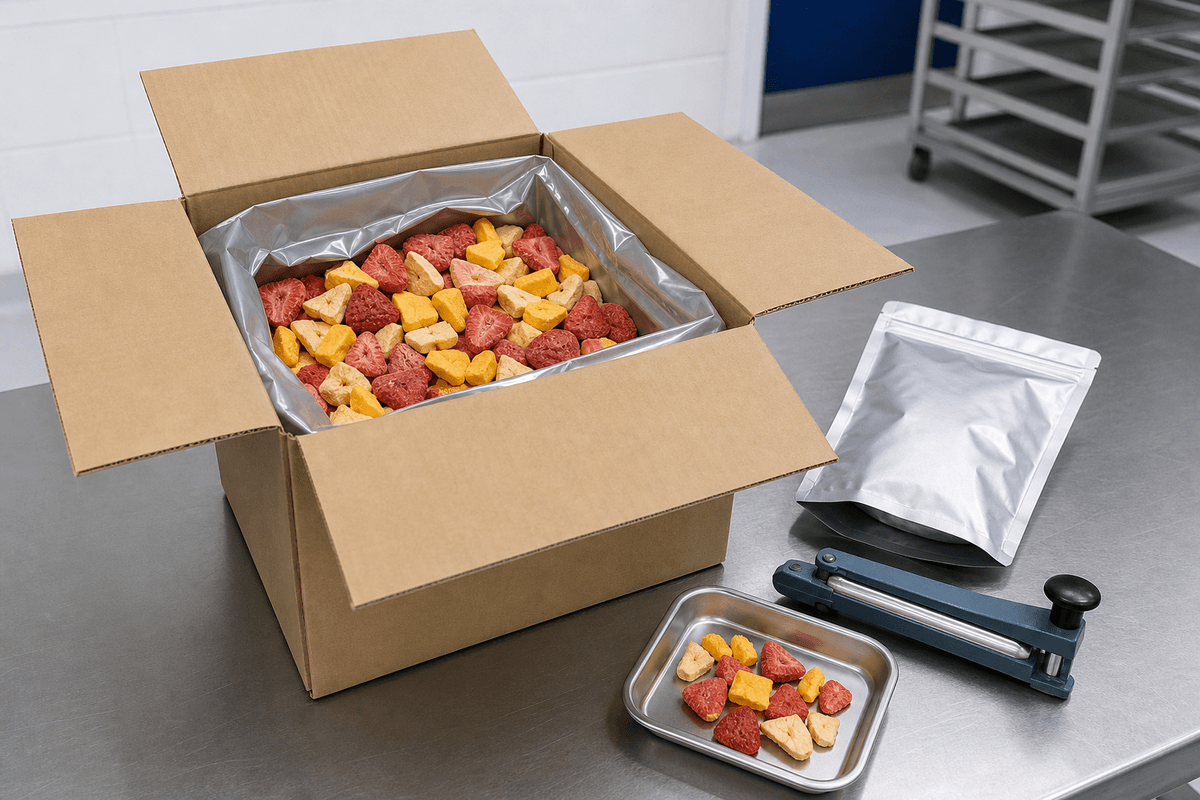
A release result taken before packing does not prove that the fruit will remain in the same condition after sealing, export handling, and warehouse storage. Freeze-dried fruit is porous, so a weak seal, damaged liner, humid packing room, or repeatedly opened container can change texture. Pair the laboratory result with seal inspection, retained samples, and a short storage or handling trial in the proposed pack.
- For pieces: Recheck crispness, breakage, fines, color, and application performance after transport simulation.
- For powders: Check flowability, caking, bulk density, mesh distribution, and dispersibility after storage.
- For blends: Verify that components do not segregate and that moisture migration does not soften the most sensitive fruit.
- For opened packs: Define resealing, handling time, room humidity expectations, and the remaining product inspection.
Plan For Laboratory Differences Before They Occur
The specification should state what happens when supplier and receiving results disagree. First confirm lot identity, units, method version, sample preparation, equipment condition, and the time the sample was exposed before testing. Compare sealed retained portions rather than repeatedly testing material from an open bag. If a referee laboratory may be used, identify it or define the qualification requirements before shipment.
A retest plan should also specify whether the original result remains part of the lot record and how many results are needed for disposition. Averaging incompatible methods or choosing only the lowest result can hide a real process or packaging problem. A documented comparison protects both parties and gives the drying or packing team evidence for root-cause work.
Align The Specification With The Fruit Format
Huaping Jingnan presents a broad freeze-dried fruit range that includes mango, apple, banana, pineapple, kiwi, citrus, dragon fruit, passion fruit, fig, and durian. Each fruit and cut can behave differently during drying and storage. Buyers should confirm the exact format and method for the item under discussion rather than transferring one moisture value across the full category.
Where a project needs a special cut, powder, blend, or bulk pack, Huaping Jingnan's sample-development and packaging workflow can be used to approve the analytical method together with the application sample. That approach gives production and receiving teams the same evidence for commercial release.
Conclusion
A practical freeze dried fruit moisture content specification defines how the number is produced and what product behavior it is meant to protect. Agree the method, sampling, pack condition, decision rule, and application check before the first commercial lot. The result will be easier to interpret and far more useful than an isolated percentage.