
Water activity of freeze dried fruit is often treated as a single pass-or-fail number. In practice, it is more useful as part of a system that includes total moisture, fruit composition, particle size, packaging barrier, storage temperature, and the final food application. Buyers need to know what was measured, under what conditions, and how the result relates to texture and stability.
FDA defines water activity as the ratio of the vapor pressure of water in a food to that of pure water under the same conditions. It can also be related to equilibrium relative humidity divided by 100. This makes water activity different from total moisture. One measures available water at equilibrium; the other measures water content according to a selected analytical method.
Why Similar Moisture Results Can Behave Differently
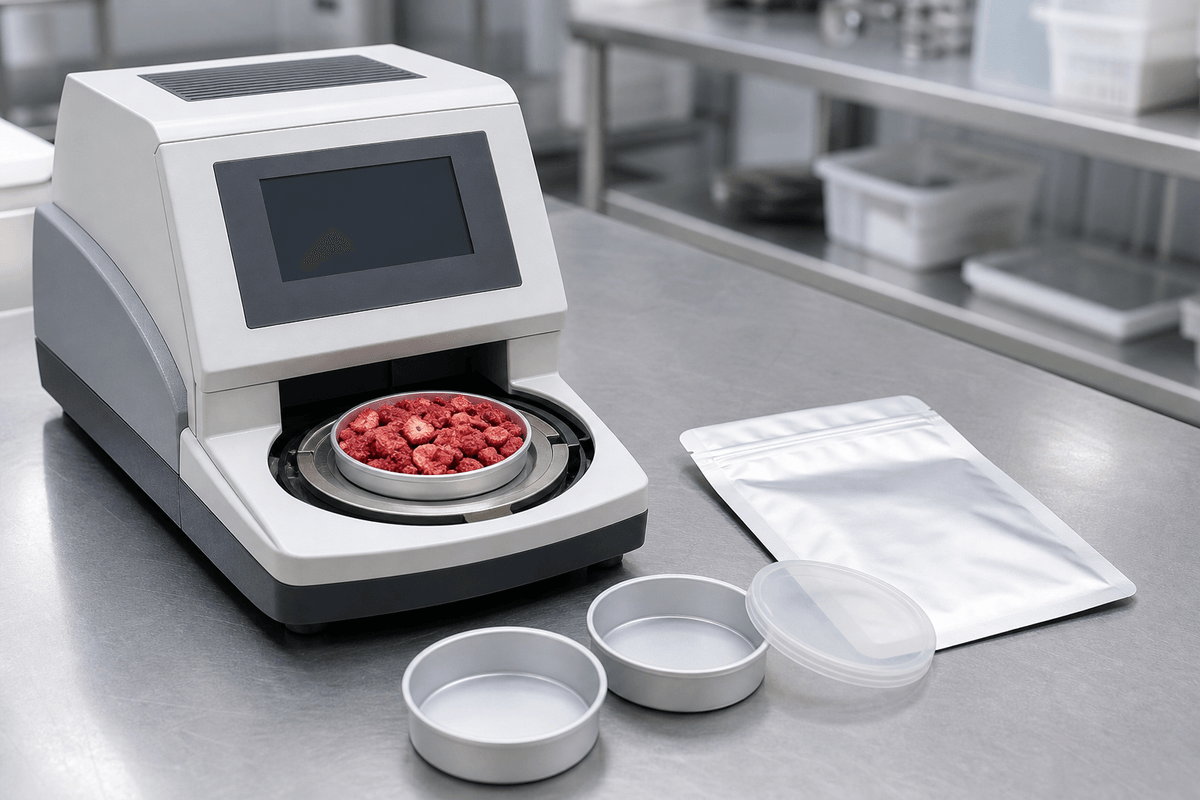
Fruit contains sugars, acids, fibers, and other solids that bind water in different ways. Strawberry pieces, banana slices, apple dice, and fruit powders can therefore show different texture or caking behavior even when their reported moisture percentages are close. Particle structure also matters: fine powder has more exposed surface area than a large piece and can respond faster to humid air.
Water activity helps describe this behavior, but it does not replace a product trial. A cereal manufacturer still needs to check whether fruit stays crisp after blending and storage. A yogurt topping developer needs to measure how quickly pieces soften after contact. A powder user needs to monitor flowability and clumping after the pack is opened.
Measurement Conditions Are Part Of The Result
FDA notes that water activity increases with temperature and that temperature differences between the sample and headspace can significantly affect readings. The sample also needs time to reach equilibrium inside the test chamber. A buyer comparing supplier and receiving results should therefore confirm the instrument principle, calibration practice, sample preparation, measurement temperature, equilibration end point, and whether duplicate results are required.
Do Not Turn A Regulatory Boundary Into A Quality Target
FDA discusses a water activity of 0.85 as a regulatory boundary in specific contexts involving low-acid canned and acidified foods. That number should not be copied as the commercial quality target for freeze-dried fruit. A fruit topping can lose the intended crispness or a powder can cake well before a broad regulatory boundary becomes relevant. Buyers need a lower, product-specific acceptance range supported by application and storage evidence, without assuming one value fits every fruit.
The specification should also distinguish food-safety review from texture control. Low water activity can limit microbial growth under defined conditions, but it does not remove the need for raw-material controls, hygienic post-drying handling, microbiological specifications, pack integrity, and traceability.
Use Water Activity To Validate Packaging
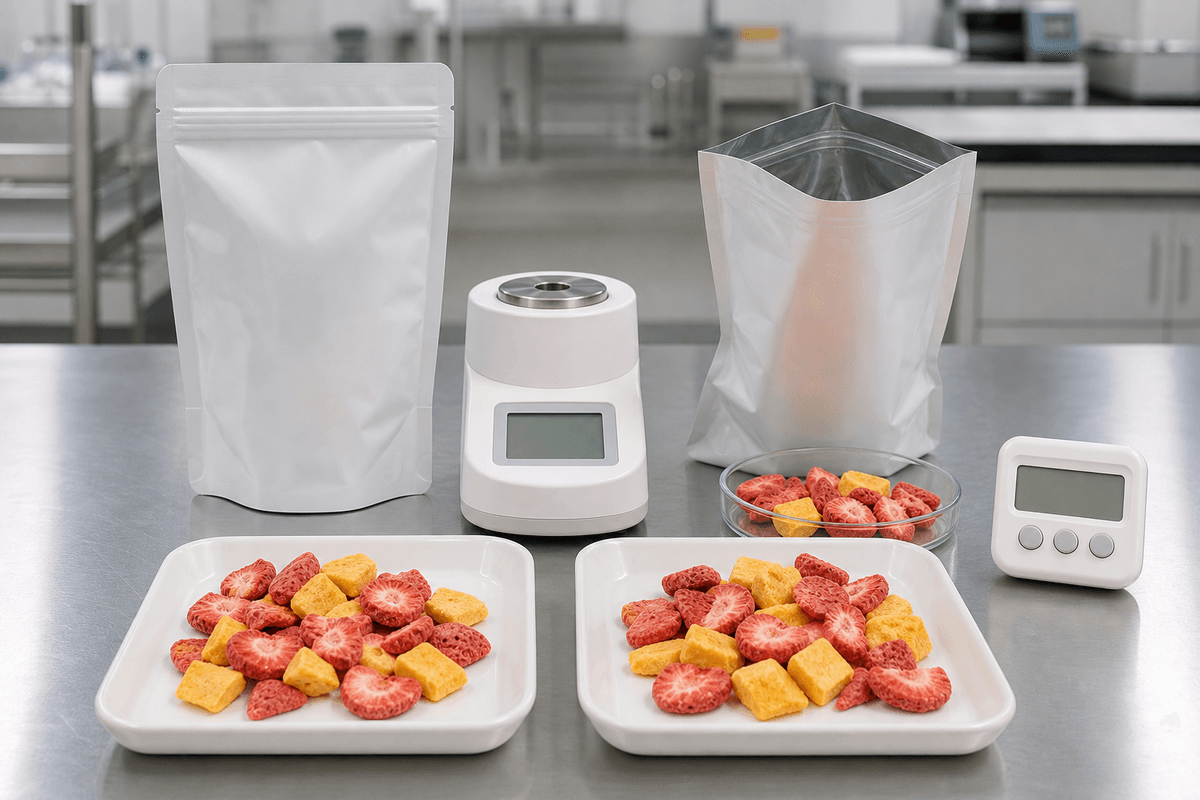
A water activity result taken immediately after drying describes only one point in the product's life. Repeat measurements after packing, simulated distribution, and storage can show whether the liner and seal protect the fruit. For open-pack use, measure the product after the expected production exposure time and compare texture, flow, and application performance.
- Bulk toppings: Compare retained samples from sealed and repeatedly opened packs.
- Fruit powder: Track water activity together with clumping, flowability, and bulk density.
- Cereal pieces: Combine the result with a pouch shake, fines measurement, and bowl trial.
- Blends: Check whether moisture migrates between fruit pieces and other ingredients.
Investigate An Unexpected Reading In A Fixed Order
When a lot gives an unexpected water activity result, begin with sample and instrument controls before concluding that the dryer failed. Confirm the pack was still sealed, the product and lot were correct, the instrument was verified with suitable standards, and the sample reached the specified temperature. Then repeat the agreed method on a protected retained portion.
If the result is confirmed, examine moisture content, pack seals, exposure time, room humidity, particle profile, and storage history. Compare product from different pack locations and look for local softening or clumping. This sequence separates measurement variation from a real process or barrier failure and prevents an isolated reading from becoming an unsupported explanation.
Product-Specific Water Activity Discussions
Huaping Jingnan's strawberry, blueberry, raspberry, blackberry, and mulberry range gives buyers several matrices and formats to evaluate. A berry piece used as a visible topping should not automatically inherit the target used for a milled powder or a mixed fruit inclusion.
The company describes professional QC laboratories and controlled packaging areas within its freeze-dried food production setup. Buyers can use that capability discussion to agree where water activity is checked, how samples are conditioned, what appears on the COA, and how the pack is validated for the exact order.
Conclusion
Water activity of freeze dried fruit is valuable when the buyer understands the measurement and connects it to the real application. Specify temperature, equilibration, sample preparation, pack exposure, and decision rules. Then verify that the chosen range protects texture, powder flow, and finished-product performance throughout storage and use.