
In contract freeze drying of supplied materials, the buyer owns or nominates the raw fruit or vegetable and the processor performs agreed operations. This arrangement can preserve a specific origin, variety, harvest relationship, or proprietary input, but it also creates an important question: where does the supplier's responsibility end and the processor's responsibility begin?
Huaping Jingnan states that partners may provide raw fruits or vegetables while the factory handles sorting, freeze-drying, packaging, and quality control. That supplied-material processing model becomes workable only after both parties define incoming acceptance, process scope, expected losses, testing, ownership, and disposition.
The Raw Material Is Part Of The Process Specification
Freeze-drying cannot make inconsistent raw material uniform. Variety, maturity, soluble solids, acidity, tissue structure, size, temperature, bruising, decay, and time from harvest all affect preparation yield and dried quality. Overripe fruit may collapse or stick; underripe fruit may have weak flavor; mixed sizes may dry unevenly unless cut and loaded appropriately.
An incoming specification should state the material form, permitted defects, temperature, packaging, lot identity, delivery window, pesticide or contaminant requirements, and documents accompanying each load. Agree who samples the shipment, which methods are used, and whether material can be conditionally accepted while results are pending.
Treat Yield As A Mass Balance
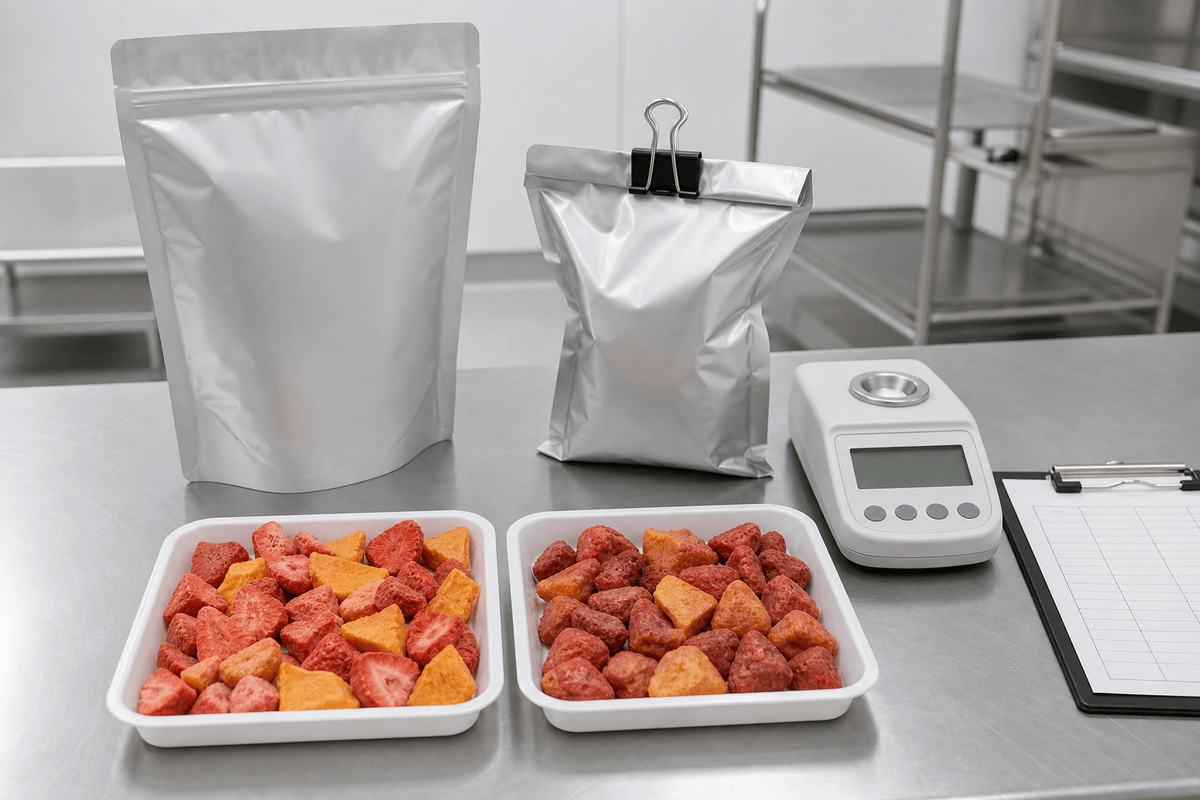
Fresh-to-dried yield depends heavily on the raw material's initial water content and usable solids. Commercial yield also includes sorting loss, peel or pit removal, trimming, cutting loss, tray residue, broken pieces, screening, laboratory samples, and packing loss. A single guaranteed conversion ratio is risky before representative trials.
Record delivered gross weight, accepted net raw weight, preparation loss, dryer input, dried output, each graded fraction, samples, and packed quantity. State whether fines are returned, packed separately, converted to powder, or discarded. This mass balance lets both parties distinguish natural process loss from unexplained variance.
Validate A Cycle For The Supplied Material
Product thickness, sugar content, cellular structure, tray loading, freezing behavior, primary drying, and secondary drying influence cycle performance. A cycle used for one strawberry source may not be appropriate for a different variety or cut. The development run should verify that centers are dry and that moisture or water activity is reasonably uniform across trays and load positions.
Freeze-drying removes water through sublimation, but it should not be described as a microbial kill step. The safety plan must therefore begin with suitable raw material and hygienic handling. Microbiological limits, pesticide residues, heavy metals, allergens, foreign-material controls, and metal detection should be assigned according to the product and destination rather than copied from an unrelated standard item.
Build Identity Preservation Into Traceability
If supplied materials are chosen for a named farm, origin, variety, or claim, lot identity must survive receiving, cold storage, preparation, tray loading, drying, grading, and packing. Agree whether lots may be pooled. Define cleaning and line-clearance expectations before and after the run, especially when allergen or claim status matters.
- Use a unique incoming lot and processing order reference.
- Record raw-material, tray or load, packed-lot, and packaging-material links.
- Keep retained raw and finished samples when feasible.
- Specify confidentiality and ownership of formulas, process data, and rejected goods.
- Require written approval before substitution, commingling, or rework.
Choose Packaging Before The Material Arrives
Very dry fruit can take up moisture quickly after unloading. The pack format, liner, seal method, fill weight, carton, labels, and pallet pattern should be available before production. If the buyer supplies packaging, the processor should approve its machine compatibility and condition before the run. If the processor supplies it, barrier and dimensions should be documented.
The commercial agreement should also address title to the raw material and finished goods, insurance while material is at the factory, storage charges, production scheduling after late delivery, and treatment of unavoidable loss. If an incoming lot fails, state whether the buyer may replace it, authorize re-sorting, redirect it, or require disposal. These clauses are operational controls: they keep questionable material from waiting in an undefined status beside accepted lots.
Before the first shipment, run a small compatibility review using representative material. Confirm that crates, liners, labels, and pallet units fit receiving and cold-storage practices. Share a delivery notice with lot numbers, weights, harvest or production dates, temperatures, and expected arrival. This gives the processor time to prepare sampling tools, storage space, labor, and the agreed production sequence.
Huaping Jingnan shows fruit, vegetable, berry, and other formats across its freeze-dried product examples. Those examples can help define the intended whole, sliced, diced, or powder outcome, but availability and processing suitability must be confirmed for the buyer's exact material. A supplied-material proposal should start with a representative sample, seasonal volume, delivery condition, target format, destination, testing plan, and packaging brief submitted through the contract processing inquiry.