
A freeze-dried fruit sample is useful only when it answers a commercial question. A beautiful piece examined at a desk may fail in cereal, fracture in a pouch, soften beside a moist ingredient, or create too much dust on a filling line. Sample development should progressively reduce those risks rather than end with a simple yes or no.
Huaping Jingnan lists optional sample development within its custom freeze-dried product process. Buyers get more value from that step when they provide a formula, process description, target serving, package, and measurable acceptance criteria.
Round One: Screen The Product Concept
The first sample establishes whether the fruit type and format are directionally suitable. Compare whole, slice, dice, granule, or powder options according to how the ingredient will be used. Review color, aroma, flavor balance, visible defects, seed or peel presence, piece geometry, and initial texture. For powder, record whether it is pure fruit or includes a carrier; then review mesh, bulk density, flow, caking, and dispersibility.
Do not create a narrow visual standard from one handful. Natural fruit varies by variety, maturity, season, and process lot. Ask for enough material to observe the expected range and photograph acceptable and unacceptable examples.
Round Two: Test The Ingredient In The Real Formula
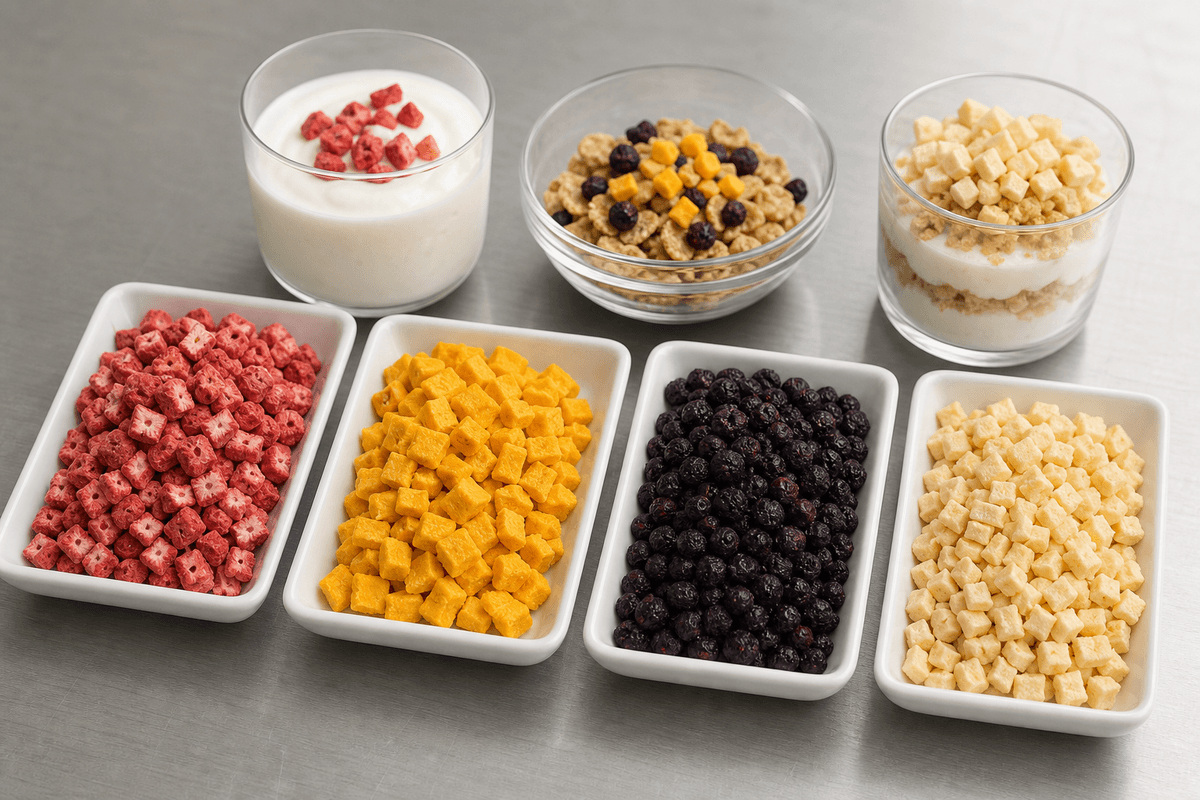
Application testing should reproduce the important stresses in manufacturing and use. In cereal, measure fines after dry blending and bowl texture over the expected eating time. In chocolate, check moisture migration and texture during storage. In instant oatmeal, test rehydration at the consumer's water temperature and standing time. In snack seasoning, evaluate powder adhesion, color uniformity, and flavor release.ApplicationSample QuestionUseful TestDry snack mixWill pieces survive handling and remain evenly distributed?Pouch shake, sieve analysis, and top-middle-bottom composition check.Bar or chocolateWill the fruit stay crisp or become hard, soft, or chewy?Short storage trial in the final matrix and package.Powdered mixWill powder flow, disperse, and deliver stable color?Humidity exposure, dosing repeatability, dispersion, and color measurement.
Round Three: Convert Preferences Into Limits
Once the preferred sample is chosen, write a draft specification. For pieces, include nominal dimensions and tolerances, sieve distribution, maximum fines or broken pieces, color range, moisture or water activity, sensory profile, foreign-material expectations, and microbiological criteria. For powders, add mesh distribution, bulk density, flowability, caking, carrier declaration, and dispersibility.
Define the method with the limit. "Low dust" is subjective; the percentage passing an agreed sieve after a stated handling procedure is reproducible. "Bright red" becomes more useful when supported by an approved physical standard, controlled photograph, or instrument range.
Round Four: Challenge The Package
Pack the sample in the intended pouch, jar, sachet, or bulk liner. Check fill height, net-weight variation, headspace, seal contamination, zipper use, and product visibility. Store units at relevant conditions and inspect moisture pickup, texture, color, aroma, clumping, and seals. A small distribution simulation can reveal breakage that an untouched bench sample hides.
- Measure fines before packing and after the transport simulation.
- Check water activity or moisture at initial and storage checkpoints.
- Compare retained controls in sealed high-barrier packaging.
- Record every sample code, date, lot, and specification revision.
- Approve the fruit and packaging together where possible.
Round Five: Confirm Scale-Up Risk

A development sample may be hand-cut, hand-screened, or selected from a small lot. Before commercial approval, ask which attributes may change at production scale: cut tolerance, loading thickness, cycle behavior, grading efficiency, bulk density, and damage during automatic filling. A pilot or first-production protocol should identify enhanced checks and the authority to stop, regrade, rework, or reject.
Huaping Jingnan displays freeze-dried berry formats and a wider fruit selection that can anchor early sample discussions. Product images can help clarify the desired visible form, but exact cut, routine availability, quality limits, and documentation need confirmation for the project.
Close The Loop With One Approval Record
The final approval record should identify the sample code, supplier lot, specification revision, application formula, test method, packaging configuration, photographs, panel result, and approvers. Keep enough retained material for comparison with the first commercial lot. This prevents later disputes caused by different teams remembering different samples.
Use blind or coded comparisons when two samples are close. Randomize presentation order and separate appearance, aroma, flavor, and texture scores so a vivid color does not dominate the whole decision. Include at least one retained control and repeat the test on another day when the result will determine a large purchase. A brief written protocol produces more reliable feedback than unstructured comments such as "sample B feels better."
Set a response window and one decision owner for each round. Consolidated feedback prevents the supplier from receiving conflicting instructions from procurement, marketing, quality, and product development. Mark every requested change as required, preferred, or exploratory, then state which previous attributes must remain unchanged. This keeps sample iteration focused and makes the final approval history understandable months later.
Buyers ready to begin can send the target application, ingredient format, sample quantity, specification priorities, destination market, and package concept through Huaping Jingnan's sample-development contact. A focused brief produces a sample that informs a decision, not merely a courier shipment.