
Fruit powder for functional foods is often selected because one ingredient can contribute fruit identity, color, flavor, acidity, solids, and a familiar consumer story. That combination is useful, but it also makes development more complicated. The powder is not a neutral delivery system. Raising the dose can change sweetness balance, texture, water binding, flow, sediment, color, and manufacturing cost at the same time.
A better development path starts by defining the job the fruit must perform. The team can then choose a fruit, powder format, dose range, process, and specification that support the finished product rather than selecting an attractive sample and trying to force it into every application.
Define The Function Before Selecting The Fruit
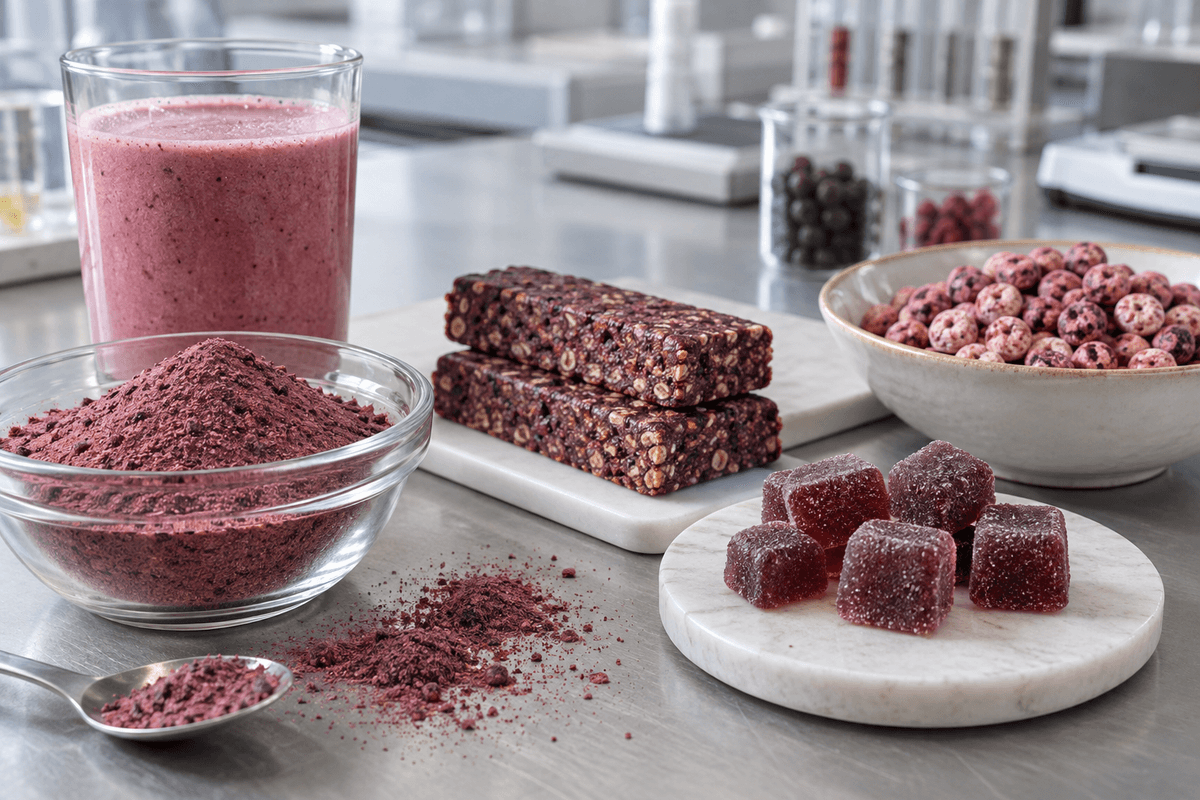
"Functional food" can describe many product types, but it does not tell a supplier what to make. State whether the powder is intended to provide recognizable fruit flavor, natural color, visible fruit solids, a measured nutrient, a standardized marker, or simply a whole-food ingredient position. Each objective requires different evidence and acceptance criteria.
A strawberry powder chosen mainly for pink color may reach its visual target before it reaches the desired flavor strength. A tart citrus or passion fruit powder may brighten flavor but reduce pH. A dark berry powder may deliver a strong purple appearance while adding seed character or astringency. The project brief should rank these functions so the supplier and formulator know which tradeoffs are acceptable.
Confirm Ingredient Identity And Composition
Specify the common fruit name and, where material, species, variety, plant part, peel or seed inclusion, and geographic source. Distinguish whole-fruit powder from juice powder, concentrate, extract, flavor preparation, and a carrier-assisted powder. These materials can share a fruit name while behaving very differently.
Ask whether maltodextrin or another carrier is present and require the complete ingredient statement. A carrier may improve powder handling or dispersibility, but it changes fruit solids per gram, flavor strength, color strength, and label declaration. A pure powder may support a simpler fruit identity yet be more hygroscopic or difficult to meter.
Huaping Jingnan displays a broad freeze-dried fruit selection spanning mango, pineapple, citrus, apple, banana, dragon fruit, and passion fruit. Its berry assortment includes strawberry, raspberry, blackberry, blueberry, and mulberry. These visible products help identify candidate fruit families, while powder availability, composition, and specifications should be confirmed for the exact project.
Find A Dose Window, Not One Perfect Number
Prepare a control and at least three fruit-powder doses in the actual base formula. Keep the mixing sequence, temperature, hold time, and sample size constant. Score fruit identity, aroma, sweetness, tartness, bitterness, astringency, color, texture, and aftertaste. Also measure application-specific behavior such as sediment, firmness, flow, or coating adhesion.
The lower end of the useful window is where the desired fruit function becomes reproducible. The upper end is where another attribute becomes unacceptable or cost-in-use stops being practical. Commercial targets should sit inside that window rather than at its edge, leaving room for normal variation in fruit and process.
Test The Complete Process
Freeze-dried fruit powder may perform well in a freshly mixed bench sample but change after heating, baking, extrusion, high shear, carbonation, homogenization, or a long hold before filling. Heat can reduce fresh aroma and alter pigments. Fruit acids can affect proteins or gelling systems. Moisture can move between fruit solids and crunchy components.
- Record the exact order of addition and mixing energy.
- Sample before processing, after processing, and after equilibration.
- Use the intended package in storage trials.
- Compare more than one powder production lot at the selected dose.
- Define which formulation or process changes require a new validation.
Design The Powder Specification Around Use
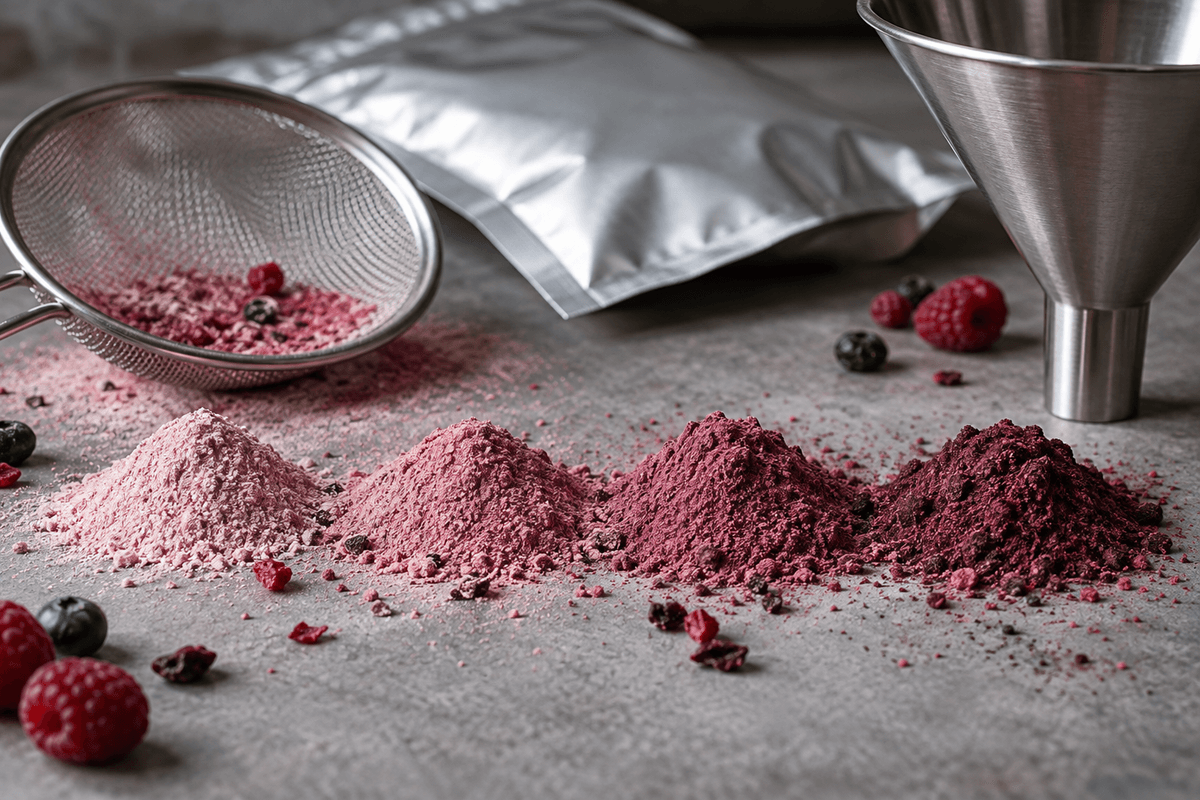
A functional-food ingredient specification should go beyond moisture and microbiology. Depending on the application, it may include complete composition, fruit identity, particle-size distribution, water activity, bulk density, flowability, color range, sensory reference, acidity, solubility or dispersibility, foreign-material controls, pesticide-residue requirements, heavy metals, microbiological limits, packaging, storage, and traceability.
Use named methods and representative sampling. "Good flow" or "high antioxidants" cannot be audited. If a bioactive marker or nutrient is commercially important, define the compound, analytical method, reporting basis, acceptance limit, and point in shelf life at which the requirement applies.
Protect A Hygroscopic Powder In The Factory
Freeze-dried powders can absorb moisture quickly. Exposure may create clumps, poor flow, dark spots, uneven dosing, and package instability. Confirm barrier packaging, liner and seal construction, pack size, storage conditions, and the permitted open time in production. A smaller pack can reduce repeated exposure when the use rate is low.
Run a handling trial under realistic room humidity. Observe hopper flow, bridging, dust, scoopability, and reclosure. This simple trial often reveals problems that do not appear on a certificate of analysis.
Keep Product Claims On A Separate Evidence Track
Fruit identity and laboratory composition do not automatically authorize a health, nutrient-content, or structure/function claim. FDA distinguishes among health claims, nutrient-content claims, and structure/function claims, and each has specific conditions. Claims must be truthful and not misleading; disease claims create a particularly important boundary.
The formulation team should define the technical ingredient first. Regulatory and legal reviewers can then assess the finished product, serving size, measured nutrient or marker, evidence, wording, and destination market. This prevents an ambitious front-of-pack story from forcing the ingredient specification after development is nearly complete.
Build A Sample Request Around Commercial Reality
Huaping Jingnan's custom fruit processing, sample development, and packaging workflow gives buyers a route to discuss fruit choice, milling, pack format, and documentation. A useful request should include the finished-food format, ingredient function, target dose range, pure-versus-carrier requirement, mesh, process conditions, package, destination market, and annual demand.
Approve the powder through the real product and retain both ingredient and finished-product samples. A commercial agreement is stronger when supplier, R&D, quality, and regulatory teams can trace every requirement back to a measured application need.
Conclusion
Fruit powder for functional foods works best when it is treated as a multifunctional ingredient with measurable jobs and tradeoffs. Defining identity, composition, dose window, powder behavior, process stability, packaging, and claim boundaries creates a practical route from an appealing fruit concept to a repeatable commercial product.