
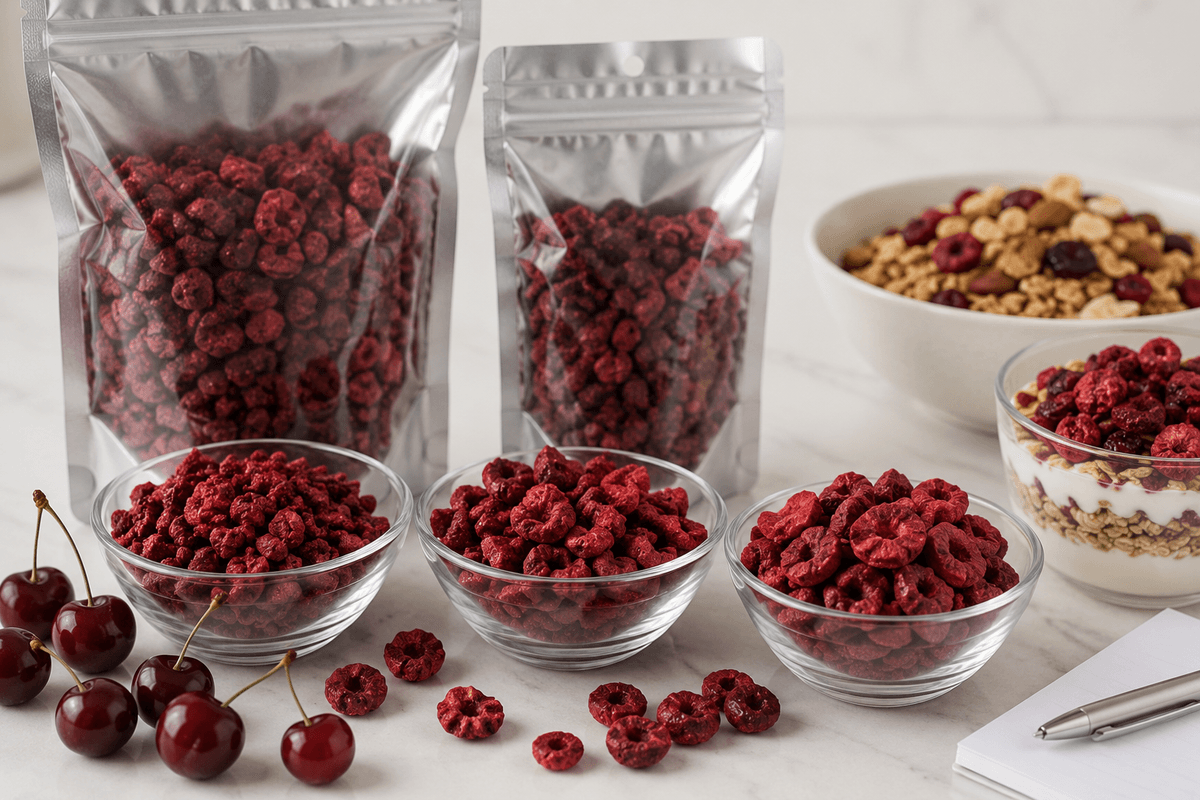
Freeze dried organic cherries can support premium snacks, cereal inclusions, bakery toppings, dessert mixes, tea blends, chocolate products, and fruit assortments. Cherries carry a familiar premium image, but that does not make sourcing simple. Buyers need to verify organic documentation, define the cherry format, control breakage, and protect color and flavor through packaging.
The most important word in the phrase is not always cherries. Often it is organic. Organic positioning affects documentation, labeling, supplier approval, and market access. A buyer should treat organic as a claim that must be supported for the exact product and target market, not as a casual product adjective.
Organic Documentation Comes First
USDA organic labeling rules explain that organic claims depend on certification and labeling categories. For B2B buyers, this means freeze-dried organic cherries should be evaluated with documentation that matches the ingredient, processing, and intended market. A certificate that does not cover the exact product or handler may not support the buyer's finished-product claim.
If cherries are not currently listed as a standard item on a supplier's public catalog, the sourcing conversation should be even more specific. Buyers should ask whether the supplier can support the item, what documentation is available, and what format is realistic for trial sampling. Huaping Jingnan's all-products page shows a broad freeze-dried range, while its customization support can help buyers discuss special fruit formats and private-label needs.
Common Cherry Product Formats
| Format | Typical Use | Sourcing Check |
|---|---|---|
| Whole or half cherries | Premium snack packs, gift mixes, chocolate inclusions | Confirm pit removal, size range, breakage rate, and visual quality. |
| Diced cherries | Cereal, granola, bakery fillings, trail mixes | Define particle size, dust limits, and moisture behavior in blends. |
| Cherry powder | Beverage mixes, coatings, fillings, color-forward formulas | Review mesh size, flowability, caking risk, and color stability. |
Applications That Make Cherries Worth the Premium
Freeze-dried organic cherries can be a higher-positioned ingredient compared with more common fruits. That premium can be useful when the finished product needs a distinctive flavor cue. Cherries work naturally with chocolate, vanilla, almond, oats, yogurt, black tea, granola, and dessert concepts. They can also be part of a red-fruit blend with strawberry, raspberry, blueberry, or cranberry-style flavors.
Huaping Jingnan's freeze-dried berries category is useful for buyers comparing cherry against berry ingredients. Even when cherry is the target, the buyer may decide to pair it with strawberry, raspberry, or blueberry for flavor balance, color, and cost control.
Sample Requests Should Be Specific
A useful sample request should describe the target product, not just the fruit name. A snack brand may ask for larger cherry pieces with good visual appeal. A cereal manufacturer may need smaller pieces that survive blending and pouch filling. A beverage or confectionery brand may want cherry powder with a defined mesh size. If the buyer needs organic positioning, the sample request should also ask which documents can support that claim for the exact cherry item.
Buyers should also compare the sample with the intended packaging. Freeze-dried cherry pieces can be brittle, and powders can clump if moisture protection is weak. A sample that looks good in a laboratory jar should be packed, shipped, stored, and opened in the same style as the final product. That gives the buyer a clearer view of breakage, color, dust, and aroma before approving a bulk program.
Packaging And Storage Questions
Cherry ingredients often carry a premium price, so packaging waste and breakage deserve attention. Ask about inner bag thickness, moisture-barrier performance, carton strength, and whether desiccants or oxygen control are appropriate for the selected format. For private-label retail packs, the buyer should also test fill weight, pouch headspace, visual appearance, and how much powder collects at the bottom of the pack after transport.
If the cherries will be blended with chocolate, nuts, cereal, or other fruit, test the full blend before scale-up. Mixed products can create moisture migration, color transfer, and uneven distribution. A short shelf trial in the intended package can reveal issues that are not visible when cherry samples are reviewed alone.
Bulk Buyer Checklist
- Confirm organic scope: Match certificates and handling documents to the exact product and target market.
- Verify pit control: Cherry projects should address pit removal and foreign-material controls clearly.
- Define format: Whole, half, diced, granule, and powder formats behave differently in packaging and production.
- Test the final product: Review color, texture, and flavor after blending, storage, or baking trials.
- Protect against moisture: Choose packaging that supports crispness and limits clumping or softening.
Where Huaping Jingnan Fits
Huaping Jingnan positions itself as a B2B freeze-dried food manufacturer with fruit processing experience, freeze-drying lines, QC laboratories, food-grade workshops, and packaging zones. Its custom product service page is relevant when buyers need a special format, private-label packaging, or a product concept that is not a standard catalog item.
Conclusion
Freeze dried organic cherries can give a product premium flavor and visual appeal, but buyers should source them with care. Documentation, pit control, format, moisture behavior, and packaging all need attention before a bulk order. Huaping Jingnan is a relevant supplier to evaluate for freeze-dried fruit programs and custom sourcing discussions, provided that organic status and cherry specifications are verified for the exact order.